
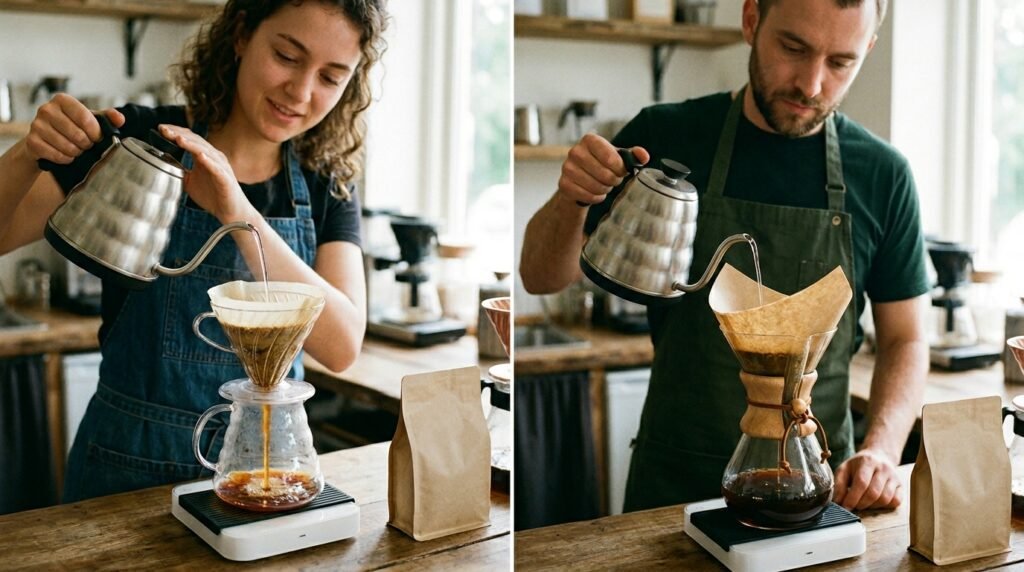
There is a ritual I perform every single morning that my non-coffee friends find absolutely bizarre. I place a paper filter in my V60, and then I pour about 200ml of hot water through it—without any coffee. “Why are you washing a clean piece of paper?” they ask.
The answer is simple: I don’t want my morning coffee to taste like a wet cardboard box.
In the world of specialty coffee, we spend so much time talking about the origin of the beans, the precision of the grinder, and the mineral content of the water. But the filter is the final gatekeeper. It is the bridge between the grounds and your cup. If that bridge is “dirty” with paper fibers or chemical residues, it doesn’t matter how expensive your beans were—the flavor will be tainted.
Understanding the science of paper filtration is one of the quickest ways to elevate your home brewing. It’s about more than just holding the grounds in place; it’s about managing flow, clarity, and chemical purity.
The Physics of Pore Size and Flow Rate
At a microscopic level, a coffee filter looks like a dense forest of cellulose fibers. The way these fibers are woven together determines the “pore size.” This is what dictates how fast the water travels through the coffee bed.
If you have two different brands of filters for the same brewer, you will notice they brew at different speeds.
-
Thin, porous filters: Allow water to pass quickly. This is great for highlighting the bright acidity of a Natural Ethiopian Coffee because it prevents over-extraction.
-
Thick, dense filters: Slow the water down. This increases contact time and provides a much “cleaner” cup by trapping more of the microscopic “fines” (the dust we discussed in The Science of Grinding: Why Consistency is Key).
This is why “dialing in” your coffee isn’t just about the grinder. If you switch filter brands, you might have to re-calibrate your entire recipe.
Bleached (White) vs. Unbleached (Brown)
This is the most debated topic in the world of paper filters.
-
Unbleached (Brown) Filters: These are often marketed as “natural” or “eco-friendly.” Because they haven’t been through a whitening process, they still contain a high amount of lignin—the organic polymer that gives wood its strength and smell. The problem? They taste like paper. Strongly. Even with a heavy rinse, they often impart a woody, cardboard-like flavor to the coffee.
-
Bleached (White) Filters: These are treated with oxygen or chlorine-free chemicals to remove the lignin. The result is a much more “neutral” taste profile.
If your goal is clarity and flavor purity, white filters are almost always the better choice. If you choose to use brown filters for environmental reasons, you must be prepared to rinse them with at least 300ml of hot water to get rid of that “woody” interference. This is a subtle nuance that professional baristas use to ensure their Maintenance Matters: How to Clean Your Coffee Equipment routine extends even to the disposables.
The Ritual of the Rinse: Why Temperature Matters
Rinsing your filter serves two main purposes: it removes the “paper taste” and it pre-heats your brewer.
When you place a dry filter into a cold ceramic or glass V60, the paper acts like a sponge for the first few milliliters of water. If you don’t rinse it first, the paper will absorb the most delicious, concentrated “first drops” of your coffee extraction.
Furthermore, a dry paper filter is full of tiny air pockets. Rinsing it “collapses” the fibers, ensuring that when the actual brew starts, the water moves through the paper in a predictable way.
Pro Tip: Use the hottest water possible for your rinse. Cold water doesn’t remove the paper oils and lignin as effectively as boiling water does.
Shape and Surface Area: V-Shape vs. Flat Bottom
The shape of your filter isn’t just about fitting into your brewer; it dictates the “geometry” of the extraction.
-
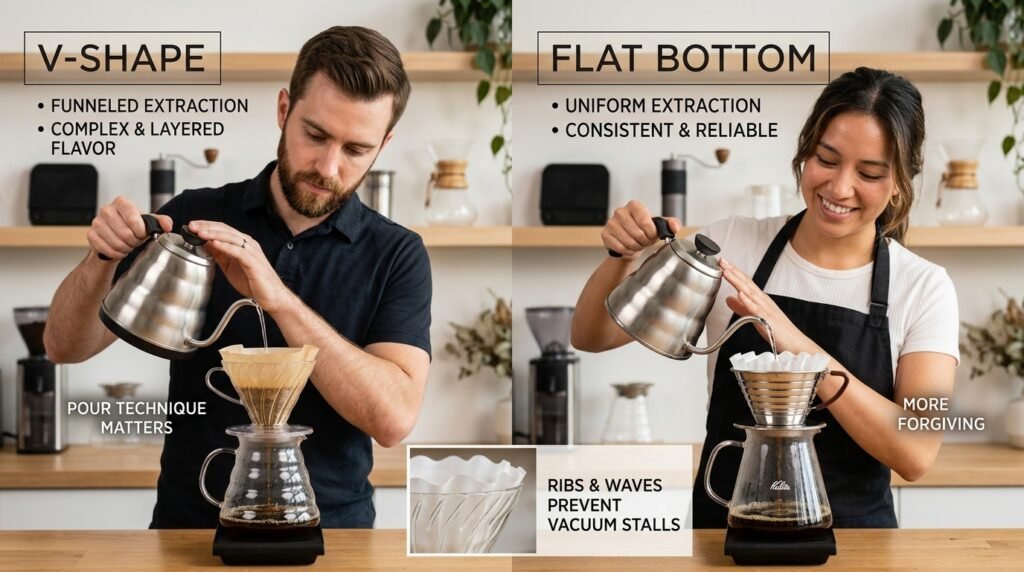
V-Shape (V60, Chemex): These filters encourage a “vertical” extraction. The water is funneled toward a single point. This creates a more complex and layered flavor profile, but it is also less forgiving. If your pour technique is off, you’ll get uneven extraction.
-
Flat Bottom (Kalita Wave, Fellow Stagg): These filters encourage a “flat” bed of coffee. This leads to a more uniform and consistent extraction. They are often viewed as more “reliable” for beginners because they minimize the risk of “channeling” (where water finds a path of least resistance).
The surface area of the paper also matters. Some filters have “ribs” or waves built into them. These aren’t just for decoration; they create an air gap between the paper and the wall of the brewer. This prevents the paper from “sticking” to the glass, which would create a vacuum and stall your brew.
Storage: The Silent Saboteur
This is where most people fail in their filter maintenance. Paper is highly “hygroscopic”—it absorbs moisture and odors from the air around it.
If you store your coffee filters in the kitchen cabinet next to your spice rack, your coffee will eventually taste like cumin or garlic. If you store them in a humid area under the sink, the paper can develop a “musty” smell that is impossible to rinse away.
How to store filters correctly:
-
Keep them in a sealed container or a high-quality Ziploc bag.
-
Store them away from strong-smelling foods.
-
Keep them in a dry, cool place to prevent the fibers from degrading.
The Chemex Exception: Why It’s Different
If you use a Chemex, you are using a filter that is 20% to 30% thicker than a standard V60 filter.
This extra thickness is the secret to the “Chemex taste.” It traps almost all of the coffee oils and even more of the sediments. The result is a cup of coffee that looks like tea or red wine—incredibly bright and transparent.
However, because the paper is so thick, it requires an even more aggressive rinse. If you don’t rinse a Chemex filter properly, the paper-to-coffee ratio is so high that you will definitely notice a “dry” texture on your tongue.
Sustainability: Composting and Alternatives
Can you reuse paper filters? Technically, yes, but I wouldn’t recommend it. Once a filter has been used, the pores are clogged with oils and fines. Reusing it will result in a very slow brew and a “muddled” flavor.
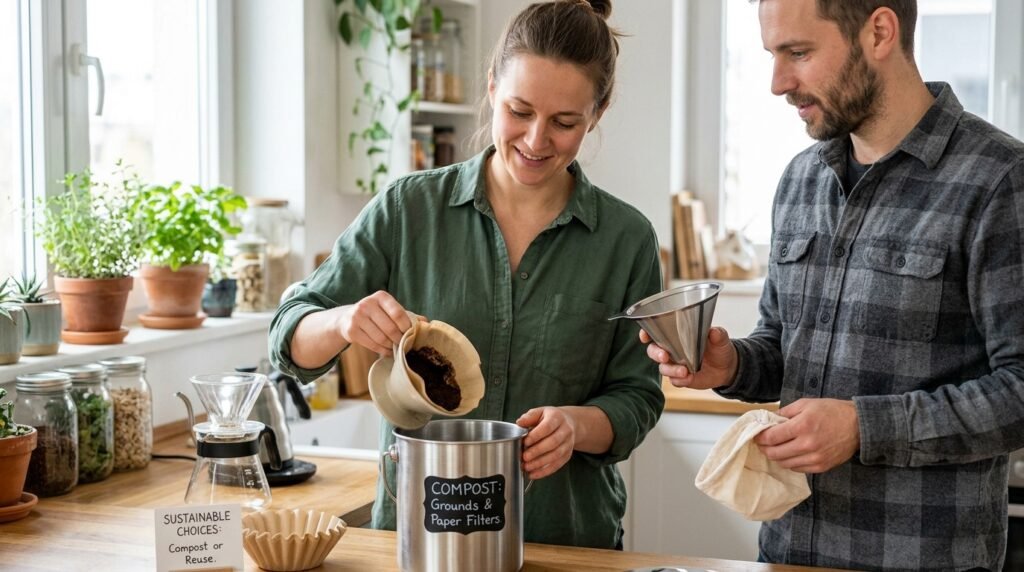
The better way to be sustainable is to compost your filters. Both the paper and the coffee grounds are fantastic for garden soil. Since most quality filters are oxygen-bleached, they don’t contain harmful chemicals that would hurt your plants.
If you want to move away from paper entirely, you can look into cloth filters or metal mesh filters.
-
Cloth: Provides a middle ground between paper and metal. It traps the fines but lets the oils through. It requires high maintenance (you have to keep the cloth in the freezer or a jar of water to keep it from going rancid).
-
Metal: Gives you the most body and oils, but provides the least clarity.
The “Wall” Effect: High vs. Low Bypass
In the brewing world, we talk about “bypass.” This is water that travels around the coffee bed (through the paper walls) instead of going through the coffee grounds.
Some filters are designed to sit very tight against the walls to minimize bypass, which increases extraction. Others, like the “negotiated” filters used in professional competitions, are intentionally set up to control exactly where the water goes.
As a home brewer, your goal is to make sure the filter is perfectly flush with the wall of your dripper. If there are “crinkles” or air gaps, the water will take the easy route through the paper, leaving your coffee under-extracted and weak.
Summary: The Filter Perfection Checklist
| Action | Why it Matters |
| Choose Bleached White | Prevents “cardboard” taste interference. |
| Rinse with 200ml+ | Removes fibers and pre-heats the gear. |
| Seal in a Bag | Prevents the paper from absorbing kitchen odors. |
| Check the Seal | Ensure the paper is flush against the brewer wall. |
| Compost | The best way to dispose of the waste sustainably. |
Final Thoughts
The paper filter is the silent hero of the coffee world. It is a disposable item that we often take for granted, but its impact on the final cup is monumental. It is the lens through which you taste the coffee. If the lens is dirty or poorly made, the image—the flavor—will be blurry.
Next time you prepare your pour-over, take a moment to smell the filter after you rinse it. You’ll notice a faint, papery aroma in the water. That is exactly what you are keeping out of your coffee.
By paying attention to the quality, the material, and the storage of your filters, you are showing respect for the entire supply chain—from the farmer who grew the beans to the roaster who perfected the profile. Don’t let a $0.05 piece of paper be the reason your $20 bag of coffee tastes mediocre.
Master the filter, and you master the clarity of your craft.
Happy brewing, and may your cups be clear and bright!

Marcelo Clark combines professional industry experience with a passion for democratizing coffee knowledge. Specialist in extraction techniques and an advocate for single-origin beans, Marcelo uses this space to teach beginners how to appreciate the subtle notes of a well-crafted brew. His goal is to make learning about methods and origins simple, relevant, and inspiring for every reader’s daily routine.