
If you have ever taken a sip of coffee and felt your face pucker from an aggressive acidity, or if you’ve experienced that dry, lingering bitterness that seems to stick to the back of your tongue, you have experienced an extraction error. In the world of Coffee Science, we aren’t just “making a drink”; we are managing a series of successive chemical reactions that occur in a matter of seconds.
Brewing coffee is, technically, a chemical washing process. We are using water as a solvent to pull soluble compounds and oils out of a complex, fibrous cellular structure. The great challenge—and the beauty of being a barista—is that these compounds do not all come out at the same time.
There is a chronological order to extraction. If you stop the process too early, you have an incomplete cup. If you let it go too long, the cup is “spoiled” by excess. Understanding this chemistry is what separates those who follow recipes from those who truly master flavor.
The Order of Extraction: What Comes Out First?
Imagine that the flavors inside a coffee bean are standing in a line, waiting for the door (the water) to open. They don’t exit as a group; they follow a very specific, orderly queue based on their molecular weight and solubility.
-
Acids and Fats: The first compounds to dissolve are the organic acids. They are chemically simple and exit almost instantly upon contact with water. Along with them come the volatile oils that carry the aroma.
-
Sugars: Right after the acids, we begin to extract the sugars and sweetness compounds. These are denser and require a bit more time and energy to dissolve completely.
-
Plant Fibers and Bitterness: Finally, the water begins to break down the deeper cellular structures and the cellulose fibers of the bean. This is where the tannins and bitter alkaloids live.
The “sweet spot” of extraction is that magical moment where you stop brewing exactly when the sweetness is at its peak, but before the heavy bitterness begins to take over. It is the balance between the sparkle of acidity and the structural foundation of bitterness.

Under-Extraction: The Brightness That Became Aggressive
When coffee is under-extracted, it means the water did not have the opportunity or the strength to pull out everything the bean had to offer. The result is an unbalanced brew where only the first in line (the acids) made it into the cup.
Under-extracted coffee tastes salty, sour, and curiously “hollow” at the end. It lacks that mouth-filling sensation that sweetness and oils should provide. This often happens because of a miscalibrated or poorly maintained grinder. If the burrs are not sharp, they create boulders—particles that are too large for water to penetrate the core in time.
To avoid this, it is essential to understand what we discussed in The Soul of the Grind: Maintaining and Calibrating Your Burrs. If you lack uniformity, half of your grounds will be under-extracted while the other half are over-extracted, creating a “flavor noise” that ruins the experience.
Over-Extraction: The Bitterness That Suffocates the Fruit
On the other end of the spectrum, we have over-extraction. This happens when the water is in contact with the coffee for too long, or when the temperature is so high that it begins to “cook” the cellulose fibers that were supposed to stay behind.
Over-extracted coffee is dry. It causes a sensation of astringency, similar to tea that has steeped for too long or an unripe banana. It “dries out” your cheeks. The bitterness here isn’t the pleasant bitterness of dark chocolate, but rather a metallic, persistent harshness.
At this point, the delicate flavors of a quality bean would be completely destroyed. You wouldn’t taste the jasmine or the fruit; you would taste only wood, ash, and smoke. This is often caused by ignoring the Maintenance Matters: How to Clean Your Coffee Equipment protocols—old residues in your machine can contribute to a “burnt” taste that mimics over-extraction.
The Role of Temperature in Solubility
Water is your solvent, and temperature is the “energy” of that solvent. The hotter the water, the faster it breaks down the coffee molecules.
-
Water Too Hot (Above 96°C): Extraction happens so fast that it is almost impossible to stop before the bitterness kicks in.
-
Water Too Cold (Below 88°C): The energy is too low to dissolve the more complex sugars, resulting in a coffee that is eternally acidic and thin.
This is why thermal stability is what defines high-quality equipment. As we saw in Precision and Longevity: The Technical Guide to Electric Kettles, having a kettle that holds exactly 92°C allows you to control the speed of this chemical reaction with surgical precision.
The Science of Surface Area
Think of the coffee particle as a labyrinth. The water needs to travel through this labyrinth to collect the flavor. If you grind the coffee too coarse, the labyrinth is simple and short—the water passes straight through and collects very little (under-extraction). If you grind too fine, the labyrinth is dense and closed—the water gets stuck inside, struggling to exit, and ends up picking up things it shouldn’t (over-extraction).
Grinding is how the barista “programs” the resistance the water will encounter. This is where science meets art. Every coffee, depending on its density and altitude, requires a different “labyrinth” size so that the water takes exactly the right amount of time to extract the best profile.

Agitation: The Invisible Catalyst
Have you ever noticed baristas stirring the coffee with a spoon during the bloom or making aggressive circular motions with the kettle? This is agitation.
Chemically, agitation increases the extraction rate by ensuring that “fresh” water (with a higher capacity for dissolution) is always touching the surface of the coffee particles. Without agitation, a layer of “saturated” water can sit around the grounds, acting as a barrier and slowing down the process.
But be careful: too much agitation is a direct path to over-extraction. Every movement must be intentional. If you are seeking that clarity of flavor we mentioned in our guide to paper filters, your agitation should be gentle and consistent, never erratic.
TDS and Yield: Measuring the Invisible
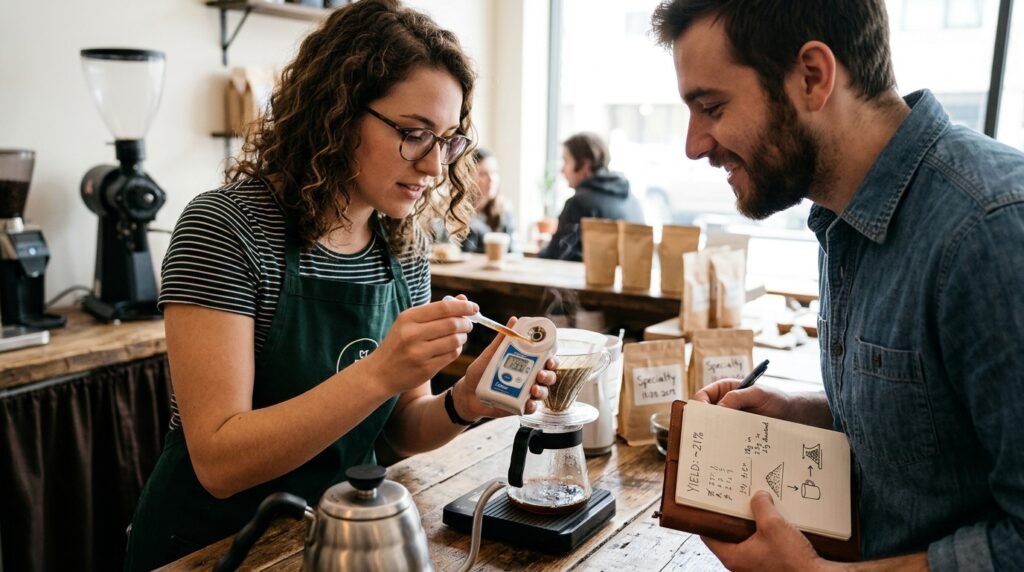
For the most fervent coffee scientists, taste is not enough; they want data. This is where two terms come in: TDS (Total Dissolved Solids) and Extraction Yield.
-
TDS: This is the measure of how “concentrated” your coffee is. It is the percentage of the drink that is actually dissolved coffee versus water. An espresso has a high TDS (8–12%), while a filter coffee has a low TDS (1.2–1.5%).
-
Extraction Yield: This is the percentage of the dry coffee weight that ended up inside the cup. The “golden number” of the industry is usually between 18% and 22%.
If you extract less than 18%, the coffee is under-extracted. More than 22%, and it begins to enter the zone of bitterness. While you don’t need an expensive refractometer at home to make good coffee, understanding these concepts helps you visualize what is happening inside your V60 or AeroPress.
Altitude and the Chemistry of Resistance
We cannot talk about the science of extraction without looking at the raw material. Beans grown at high altitudes grow slower, which creates a much denser and more complex cellular structure.
Chemically, this means these beans are more “resistant” to extraction. They hold onto their sugars and acids more tightly. Because of this, high-altitude coffees generally withstand slightly higher water temperatures and finer grinds without immediately turning bitter. They simply have more “content” to offer the water.
Summary: The Extraction Success Checklist
| Taste Signal | Chemical Diagnosis | Necessary Adjustment |
| Salty / Sour | Under-extraction | Grind finer / Use hotter water |
| Dry / Bitter | Over-extraction | Grind coarser / Use cooler water |
| Balanced / Sweet | Ideal Extraction | Maintain consistency! |
| Thin / Weak Body | Low TDS | Increase coffee-to-water ratio |
Conclusion: The Dance of Elements
The science of extraction is a constant dance between time, temperature, and surface area. There is no single setting that works for every coffee in the world, and that is what makes this hobby so addictive. Every new bag of beans is a new chemical puzzle to be solved.
When you begin to notice these nuances—when you can identify that the bitterness at the end of the sip is the result of a grind that was just a bit too fine for that temperature—you have taken the definitive step from enthusiast to specialist.
Coffee stops being just a morning drink and becomes a laboratory experience where the final result is pure sensory pleasure. Respect the chemistry, observe the details, and above all, trust your palate. It is the most accurate refractometer you own.
May your extractions always be sweet, bright, and perfectly balanced!

Marcelo Clark combines professional industry experience with a passion for democratizing coffee knowledge. Specialist in extraction techniques and an advocate for single-origin beans, Marcelo uses this space to teach beginners how to appreciate the subtle notes of a well-crafted brew. His goal is to make learning about methods and origins simple, relevant, and inspiring for every reader’s daily routine.