
I remember a specific trip I took to a coastal town a few years ago. I had brought my favorite beans, my precision grinder, and my trusted AeroPress. I followed my recipe to the milligram, yet the coffee tasted flat, salty, and dull. I thought my beans had suddenly gone stale, or perhaps the sea air was messing with my palate.
When I returned home and brewed the same beans with my filtered tap water, the magic returned. The vibrant acidity was back, the sweetness was shimmering, and the floral aroma filled the room.
That was the moment I truly understood that coffee isn’t just “coffee and water.” Coffee is a chemical reaction between ground seeds and a complex solution of minerals. If you treat water as just a neutral liquid, you are missing 98% of the story. In Coffee Science, water is the “solvency engine.” Depending on the ions floating in that water, you can either unlock a masterpiece or lock away the flavor forever.
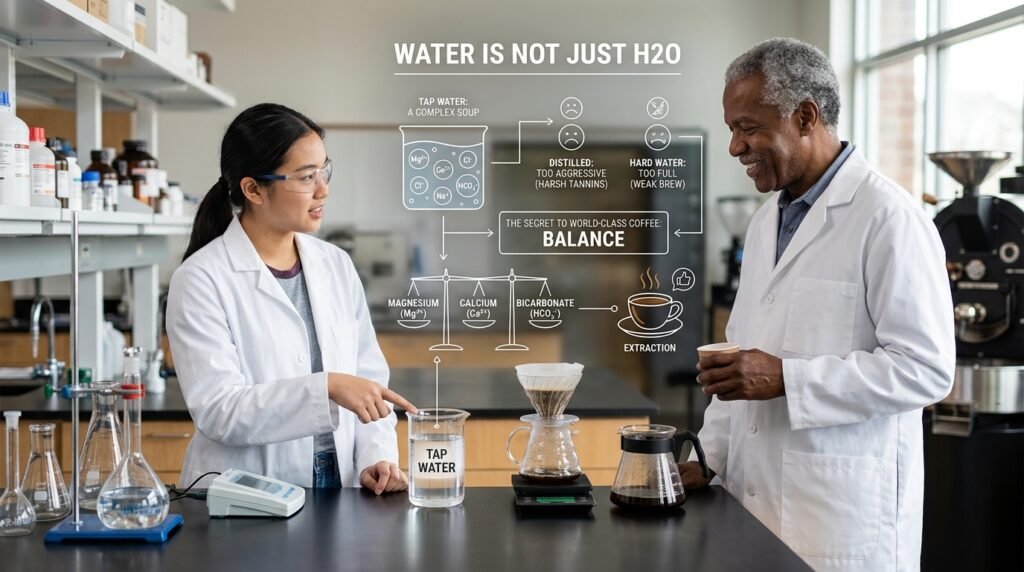
Water is Not Just H2O
In a high school chemistry lab, we learn that water is two hydrogen atoms bonded to one oxygen atom. But the water coming out of your tap is a crowded soup of minerals, chemicals, and gases. It contains Calcium, Magnesium, Sodium, Bicarbonates, Sulfates, and often Chlorine.
Each of these elements plays a specific role in how flavor is “pulled” out of the coffee grounds. If your water is too “empty” (like distilled water), it is too aggressive and pulls out everything, including the harsh tannins. If your water is too “full” (hard water), it has no room left to hold the coffee solids, resulting in a weak, chalky brew.
The secret to a world-class cup lies in the balance of three specific ions: Magnesium (Mg2+), Calcium (Ca2+), and Bicarbonate (HCO3-).
The Sticky Ion: Magnesium (Mg2+)
If there is a “hero” in coffee water chemistry, it is Magnesium. In the world of molecular physics, Magnesium is considered “sticky.”
Coffee flavor compounds—especially those responsible for bright, fruity notes—have a strong chemical affinity for Magnesium. When water flows through your coffee bed, the Magnesium ions act like tiny magnets, grabbing onto the high-energy flavor molecules and pulling them into the liquid.
Because Magnesium has a small ionic radius and a high charge density, it is incredibly efficient at pulling out complex acids. This is why The Chemistry of Extraction: Balancing Acid, Sweet, and Bitter is so dependent on your water source. Without enough Magnesium, those bright, sparkling notes of a Kenyan or Ethiopian coffee will simply stay trapped inside the grounds.
The Body Builder: Calcium (Ca2+)
Calcium is the second most important mineral in your water. Like Magnesium, it helps pull out flavor, but it has a different specialty. Calcium is particularly good at extracting the heavier, “creamy” molecules and the darker, chocolatey notes.
However, Calcium is a double-edged sword. While it adds body and “weight” to the coffee, it is also the primary culprit behind limescale build-up in your equipment. As we discussed in Precision and Longevity: The Technical Guide to Electric Kettles, high calcium levels will eventually clog your heating elements and sensors.
From a flavor perspective, too much Calcium can make the coffee feel “heavy” or “chalky,” masking the delicate floral notes that make specialty coffee unique.
The Buffer: Bicarbonates and Alkalinity
While Magnesium and Calcium are the “attackers” that pull flavor out, Bicarbonates are the “defenders.” In chemistry, we call this Alkalinity (not to be confused with pH).
Bicarbonates act as a buffer. They neutralize acids. If your water has zero alkalinity, your coffee will taste incredibly sharp, sour, and “vinegary” because the natural acids in the coffee have nothing to balance them out.
However, if your alkalinity is too high, the Bicarbonates will neutralize all the good acids. This is what makes coffee taste “flat” or “boring.” If you’ve ever had a coffee that had plenty of body but zero “pop” or brightness, your water likely had too much bicarbonate buffer.
Finding the “Goldilocks zone” for alkalinity is the hardest part of water science. You want just enough to smooth out the sharp edges, but not so much that you kill the personality of the bean.
The Danger of Distilled and RO Water
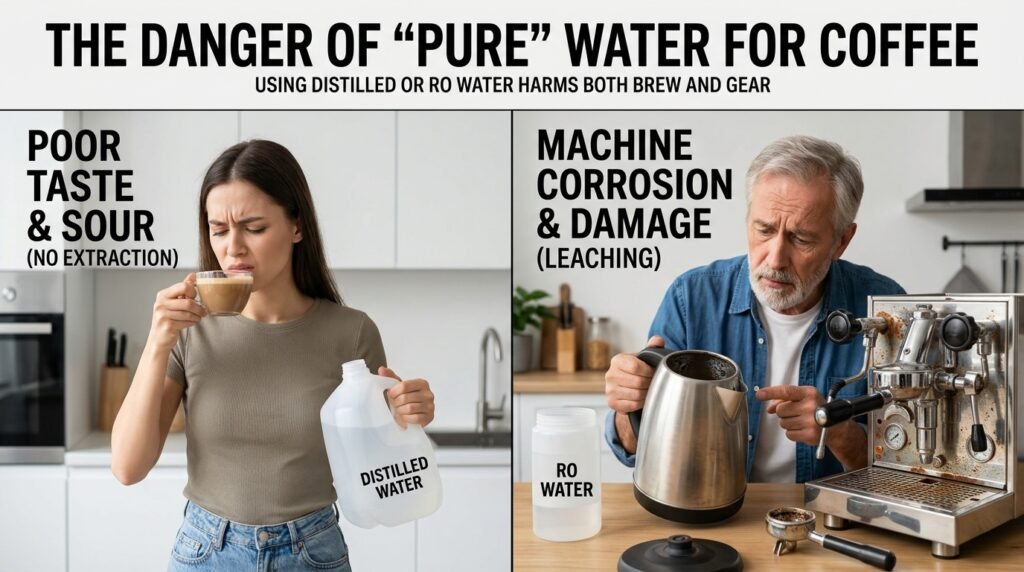
A common mistake beginners make is using distilled water or zero-filter water because they want “pure” coffee. This is a scientific disaster for two reasons:
-
Extraction Failure: As we established, you need minerals to pull flavor out. Distilled water has zero minerals. Without Magnesium and Calcium “magnets,” the water passes through the coffee and fails to extract the sweetness. The result is a cup that is paradoxically both sour and flat.
-
Equipment Corrosion: Distilled water is “hungry.” Because it has no minerals, it becomes chemically unstable and seeks to pull minerals from its environment—specifically the metal inside your kettle or espresso machine. This is called “leaching,” and it will eventually ruin your gear.
If you use a Reverse Osmosis (RO) system, you must “re-mineralize” the water before brewing. This is why many enthusiasts use products like Third Wave Water or create their own “concentrates” using Epsom salts and baking soda.
Chlorine: The Flavor Destroyer
If there is one thing that should never be in your coffee water, it is Chlorine. Cities add Chlorine to tap water to kill bacteria, which is great for health but terrible for coffee.
Chlorine reacts with the phenols in coffee to create a compound called chlorophenol. Even in tiny amounts (parts per billion), chlorophenol tastes like medicine or plastic. If your tap water smells like a swimming pool, your coffee will taste like a hospital.
A simple carbon block filter is usually enough to remove Chlorine, which is why Maintenance Matters: How to Clean Your Coffee Equipment and keeping your filtration systems fresh is so vital for flavor purity.
The SCA Water Standard
The Specialty Coffee Association (SCA) has actually defined what “perfect” coffee water looks like. While you don’t need a lab kit to enjoy coffee, knowing these benchmarks helps you understand what you are aiming for:
-
Total Dissolved Solids (TDS): 150 mg/L (75–250 range)
-
Calcium Hardness: 50–175 mg/L CaCO3
-
Alkalinity: 40 mg/L (close to this is ideal)
-
pH: 7.0 (neutral)
-
Sodium: 10 mg/L
If your water is within these ranges, you are giving your coffee the best possible chance to shine.
DIY Water: The “Barista Hustle” Recipe
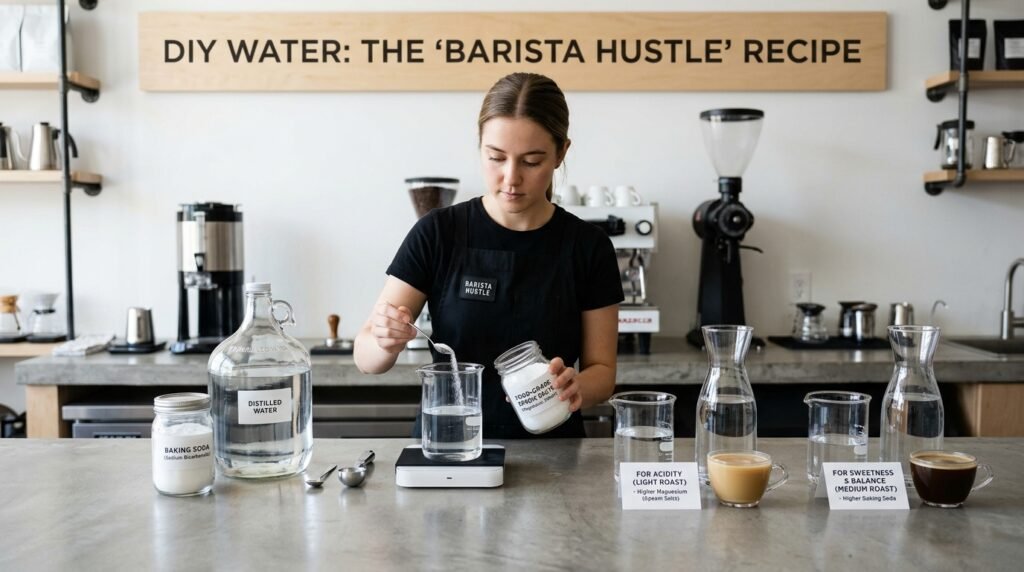
For the true coffee scientists who want total control, you can make your own “perfect water” at home using a gallon of distilled water and two simple ingredients from your kitchen:
-
Magnesium Source: Epsom Salts (Food grade Magnesium Sulfate).
-
Buffer Source: Baking Soda (Sodium Bicarbonate).
By adding precise amounts of these to distilled water, you can create a “recipe” that highlights different things. Want more acidity for a light roast? Boost the Magnesium. Want more sweetness and balance for a medium roast? Boost the Baking Soda. This is the ultimate level of coffee customization.
Temperature and Mineral Solubility
Temperature doesn’t just affect the coffee; it affects how the minerals in the water behave. Hotter water increases the “kinetic energy” of the ions, making them even more aggressive at pulling out compounds.
This is why, when you change your water source, you often have to change your brewing temperature. If you move to a “harder” water area, you might need to drop your temperature to avoid over-extracting the bitter compounds that the extra Calcium is pulling out.
Summary: The Water Chemistry Checklist
| Mineral | Role | Too Much | Too Little |
| Magnesium | Pulls out bright acids and fruit. | Can cause heavy, metallic taste. | Flat, dull, one-dimensional flavor. |
| Calcium | Adds body and creamy texture. | Limescale build-up; chalky taste. | Thin, watery mouthfeel. |
| Bicarbonate | Balances and buffers acidity. | Flat, “dead” taste; no brightness. | Sour, sharp, vinegary acidity. |
| Chlorine | Disinfectant. | Medicinal, plastic, “pool” taste. | (This is the only one you want at zero!) |
Final Thoughts
The next time you fill your kettle, take a second to think about the invisible army of ions waiting to jump into your coffee grounds. Water isn’t just the medium; it’s an active participant in the extraction.
When people ask me why their coffee doesn’t taste like the stuff in a high-end cafe, 90% of the time, the answer is the water. You can buy the most expensive gear and the highest-rated beans, but if you are brewing with poor water, you are building a skyscraper on a foundation of sand.
Start simple. Try brewing your favorite coffee with a bottle of soft spring water (check the label for low mineral content) and compare it to your tap water. The difference will likely shock you. Once your eyes (and tongue) are opened to the science of water, there is no going back.
You’ve mastered the beans, the grind, and the brew. Now, master the water. It’s the final frontier of the perfect cup.
Happy brewing, and may your ions always be in balance!

Marcelo Clark combines professional industry experience with a passion for democratizing coffee knowledge. Specialist in extraction techniques and an advocate for single-origin beans, Marcelo uses this space to teach beginners how to appreciate the subtle notes of a well-crafted brew. His goal is to make learning about methods and origins simple, relevant, and inspiring for every reader’s daily routine.