
If you were to walk into a high-end specialty coffee lab ten years ago and tell the baristas that one of the most respected brewing devices of the future would be a plastic tube invented by a toy manufacturer, they would have laughed you out of the shop.
At the time, “serious” coffee was about expensive Italian espresso machines or delicate glass pour-overs. But then came Alan Adler and his AeroPress.
The AeroPress didn’t look sophisticated. It looked like a giant medical syringe or a science project. Yet, within a few years, it didn’t just become popular—it spawned its own World Championship. Today, it is the undisputed king of travel brewing and perhaps the most versatile tool in any coffee lover’s arsenal.
What makes the AeroPress so special isn’t just its durability; it’s the fact that it allows you to manipulate every single variable of The Chemistry of Extraction: Balancing Acid, Sweet, and Bitter with total precision and zero mess.
The Story of the Toy Maker and the Perfect Cup
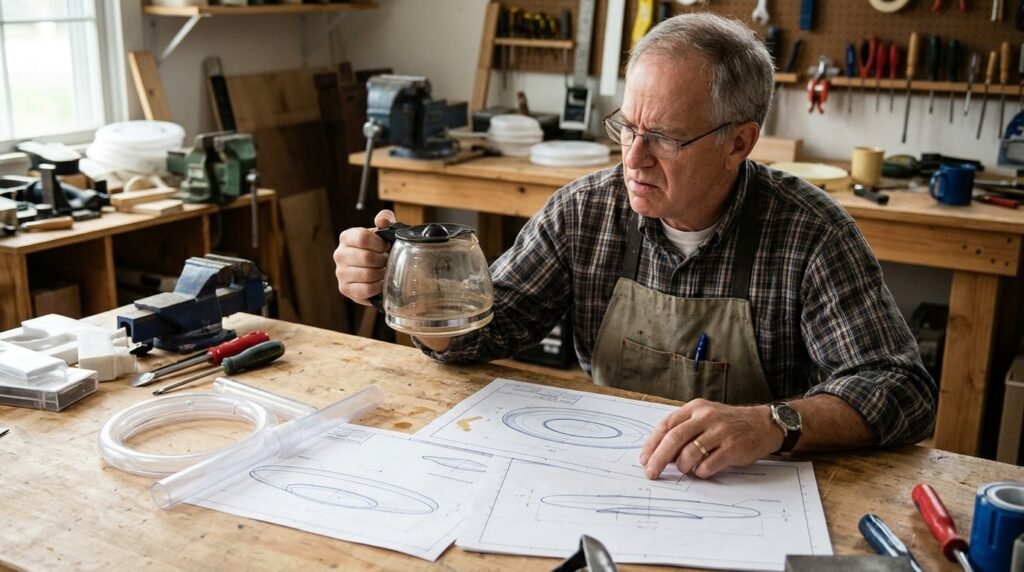
Alan Adler was an inventor and an engineer. He held dozens of patents, but he was best known for the Aerobie—a high-performance flying disc that broke world records. Adler was also a coffee lover, and he was frustrated by the inconsistency of standard drip machines.
He realized that most coffee makers struggled with two things: temperature control and brew time. He wanted a way to brew a single cup of coffee quickly, using pressure to speed up the extraction while keeping the bitterness low.
In 2005, he launched the AeroPress. The coffee world was skeptical at first. “Plastic?” they asked. “From a frisbee company?” But once they tasted the results, the skepticism evaporated. The AeroPress produced a cup that was remarkably clean, intensely sweet, and almost impossible to screw up.
How It Works: The Hybrid Brewing Method
The reason the AeroPress is so unique is that it is a hybrid brewer. In the world of coffee, there are usually two ways to extract flavor:
-
Immersion: Like a French Press, where the coffee sits in the water for the entire brew time. This creates body and richness.
-
Percolation: Like a V60 or a drip machine, where fresh water passes through a bed of coffee. This creates clarity and highlights acidity.
The AeroPress does both. The coffee steeps in the water (immersion), but then it is forced through a paper filter under pressure (percolation). This combination gives you the best of both worlds: the heavy body of a French Press with the sparkling clarity of a pour-over.
This versatility is why it works so well with a variety of beans, from a chocolatey Brazilian to a floral Natural Ethiopian Coffee.
The Two Schools of Thought: Standard vs. Inverted
Ask any ten AeroPress fans how they brew their coffee, and you will get ten different answers. However, they usually fall into two main camps:
The Standard Method
You place the AeroPress on top of your mug, add coffee and water, stir, and plunge. It’s fast and simple. The downside? Some water begins to drip through the filter before you’re ready, which can lead to a slightly less even extraction.
The Inverted Method
This is the “hack” that took the world by storm. you turn the AeroPress upside down, with the plunger already inserted. You add your coffee and water, let it steep like a French Press, and then—at the very end—you screw on the filter cap and flip it onto your mug.
The Inverted Method gives you total control over the steep time. Not a single drop of water leaves the chamber until you decide it’s time to plunge. This method is the ultimate way to experiment with The Science of the Bloom: Why Bubbles are the Key to Flavor Extraction because you can see exactly how the gas is interacting with the water through the transparent (or tinted) plastic.
The Anatomy of the Plunge
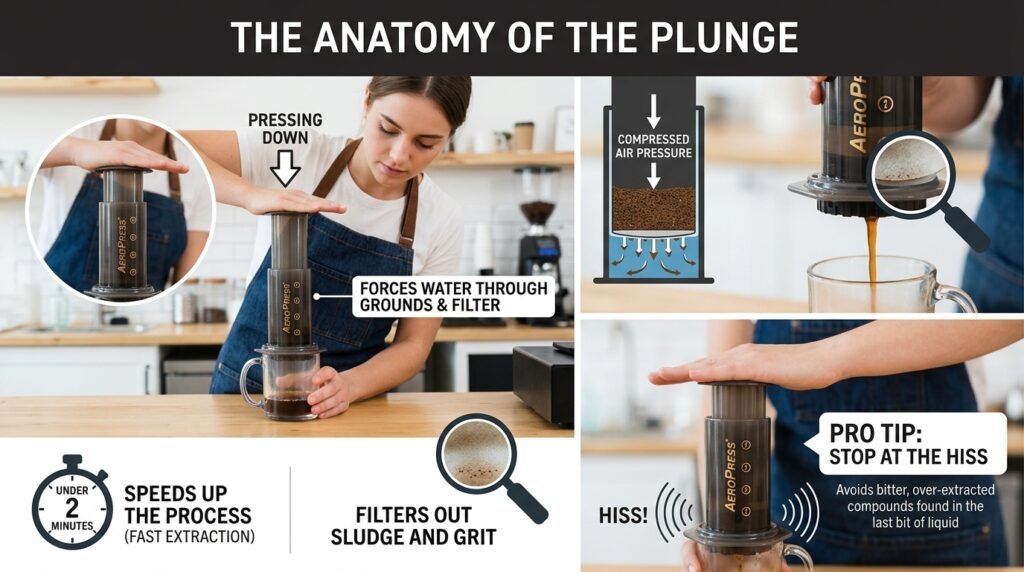
The “magic” of the AeroPress happens in the last 30 seconds. When you press the plunger down, you are creating a small amount of air pressure. This pressure forces the water through the coffee grounds and the paper filter.
This pressure does two things:
-
It speeds up the process: You can achieve a full extraction in under two minutes, whereas a French Press takes four or five.
-
It filters out the “fines”: Because of the paper filter and the pressure, you don’t get the “sludge” or grit often found in other immersion methods.
Pro Tip: If you hear a “hissing” sound at the end of your plunge, that is air escaping. Most pros stop plunging as soon as they hear the hiss. They believe that the very last bit of liquid in the puck contains the most bitter, over-extracted compounds.
The Travel Factor: Coffee Anywhere
One of the reasons the AeroPress is a staple in “Coffee Culture” is its indestructibility. It is made of BPA-free, food-grade plastic that can be dropped, thrown in a backpack, or even stepped on without breaking.
For the digital nomad or the frequent traveler, it is the perfect companion. It weighs next to nothing, and it’s incredibly easy to clean—you just pop the “puck” of used grounds into the trash and rinse the rubber seal. No scrubbing, no complicated valves, no glass to shatter in your suitcase.
It has turned hotel rooms, campsites, and airport terminals into world-class cafes. All you need is a way to heat water and a decent grinder, and you can have a better cup of coffee at the top of a mountain than most people get in a downtown bistro.
The World AeroPress Championship (WAPC)
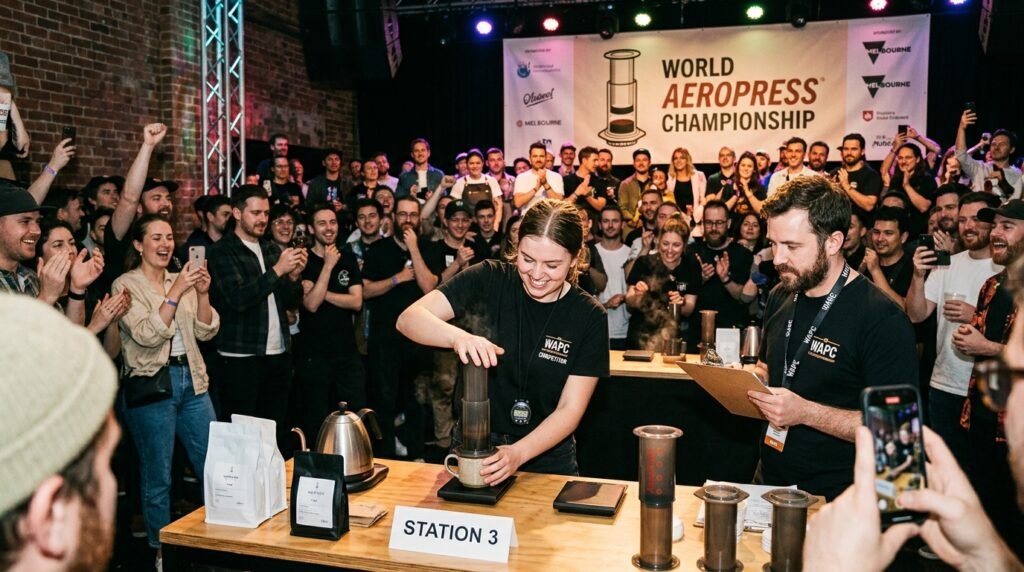
You know a brewing device is serious when it has its own global tournament. The World AeroPress Championship is unlike any other coffee competition. While most barista competitions are formal and rigid, the WAPC is a party. It’s loud, it’s fun, and it’s a celebration of the community.
Competitors from all over the world bring their own “recipes.” Some use two filters, some use high temperatures, and some use “bypass” (brewing a very strong concentrate and then adding water at the end).
The fact that people can win world titles using the same $40 plastic tube you have in your kitchen is a testament to the AeroPress design. It proves that in coffee, the “how” is often more important than the “how much it cost.”
Troubleshooting Your Brew
Because the AeroPress is so manual, there are a few things that can go wrong. Here is how to fix them:
-
Difficulty Plunging: If you have to use all your body weight to push the plunger down, your grind is too fine. You are essentially creating a wall of mud that the water can’t pass through. Grind coarser next time.
-
The Coffee is Thin/Weak: You might be plunging too fast. A slow, steady 30-second plunge ensures the water has enough time to pick up those soluble solids.
-
The Coffee is Bitter: You might be using water that is too hot. Alan Adler originally recommended 80 degrees Celsius for a reason—the pressure of the AeroPress extracts flavor so efficiently that you don’t always need boiling water.
Summary: The AeroPress Advantage
| Feature | Why It Matters | The Result |
| Material | BPA-free polypropylene. | Indestructible and travel-friendly. |
| Filter | Small, circular paper filters. | Removes oils and sediment for a clean cup. |
| Pressure | Manual air pressure. | Speeds up extraction and enhances body. |
| Versatility | Can make espresso-style or filter-style. | One tool for every mood. |
| Clean-up | The “Puck” ejection system. | Done in 10 seconds. |
Final Thoughts
The AeroPress is a reminder that innovation doesn’t always have to be expensive or complicated. Sometimes, an outsider—like a toy maker—can look at an old problem with fresh eyes and create something that changes an entire industry.
It has democratized specialty coffee. You don’t need a $2,000 espresso machine to get a rich, intense shot of coffee. You don’t need a lab-grade setup to get a clear, nuanced pour-over. You just need a plastic tube and a bit of curiosity.
Whether you are a seasoned barista or someone just starting their coffee journey, the AeroPress is a tool that grows with you. It is a playground for experimentation, a reliable friend on the road, and a symbol of the creative spirit of coffee culture.
So, if you’ve been sticking to your automatic dripper, it’s time to join the revolution. Flip that tube, start your timer, and see what kind of magic you can squeeze out of those beans.
Happy plunging, and may your recipes always be award-worthy!

Marcelo Clark combines professional industry experience with a passion for democratizing coffee knowledge. Specialist in extraction techniques and an advocate for single-origin beans, Marcelo uses this space to teach beginners how to appreciate the subtle notes of a well-crafted brew. His goal is to make learning about methods and origins simple, relevant, and inspiring for every reader’s daily routine.