
There is a specific kind of nostalgia attached to the French Press. For many of us, it was the first “serious” coffee tool we ever bought. It looked sophisticated on the kitchen counter, and the act of pressing down the plunger felt like a true morning ritual.
However, for just as many people, the French Press is a device that eventually gathers dust in the back of a cabinet. Why? Because their first experience was a cup of muddy, bitter, and sediment-heavy liquid that tasted more like a swamp than a specialty beverage.
But here is the truth: the French Press isn’t the problem. The way we were taught to use it is.
In the hierarchy of coffee brewing, the French Press represents the pinnacle of Full Immersion. Unlike a pour-over where water passes through the grounds, in a French Press, the water and coffee sit together in a deep, warm embrace for the entire duration of the brew. This creates a texture and a flavor profile that no paper filter can ever replicate. If you want to experience the true “soul” of a coffee bean’s oils and fats, the French Press is your best friend.
The Science of Immersion vs. Percolation
To understand why the French Press tastes so different from a V60, we have to look at the physics of the water.
In a percolation method (like the V60), fresh water is constantly flowing through the coffee. This is very efficient at stripping away flavors, which is why it requires a fine grind and precision pouring. You can read more about this dynamic in Mastering the Hario V60: The Art and Physics of the Perfect Pour-Over.
In an immersion method (the French Press), the water becomes saturated with coffee solids over time. As the water “fills up” with flavor, its ability to extract more flavor slows down. This makes immersion brewing much more “forgiving.” It is harder to over-extract a French Press because the chemistry naturally slows down as the liquid reaches equilibrium.
This results in a cup that has a much heavier “mouthfeel.” Since there is no paper filter to soak up the coffee oils (lipids), those oils end up in your cup, creating a creamy, velvety texture that coats the tongue.

The Grind: The Foundation of Clarity
The biggest mistake people make with a French Press is using the wrong grind. Because the coffee sits in the water for a long time, you need a very coarse grind—think of sea salt or cracked peppercorns.
If your grind is too fine, the water will extract too much bitterness from the surface area of the particles. Furthermore, fine grounds will bypass the metal mesh filter, leaving you with that “muddy” texture that ruins the experience.
This is where the quality of your equipment becomes a life-saver. As we’ve detailed in The Soul of the Grind: Maintaining and Calibrating Your Burrs, having a grinder that can produce consistent, large particles without creating “fines” (coffee dust) is the difference between a clean French Press and a gritty one.
The “James Hoffmann” Revolution: A New Way to Press
For decades, the instructions for a French Press were simple: add coffee, add water, wait 4 minutes, and plunge.
But the specialty coffee community, led by experts like James Hoffmann, realized that 4 minutes isn’t nearly enough time for the grounds to settle. If you plunge immediately at 4 minutes, you stir up all the silt and sediment, forcing it into your cup.
The “Modern French Press” technique involves a bit more patience, but the result is a cup of coffee so clean it could almost pass for a pour-over, yet with the body of a classic immersion.
-
The Brew: Add your coffee and water. Let it sit for 4 minutes.
-
The Break: After 4 minutes, take a spoon and gently stir the “crust” that has formed on the top. The grounds will sink to the bottom.
-
The Clean: Use two spoons to scoop out any floating foam or stray grounds. This foam often carries the most bitter, unpleasant flavors.
-
The Wait: This is the hard part. Let the coffee sit for another 5 to 7 minutes. Don’t worry—it won’t get cold! The glass and the volume of water keep it at the perfect drinking temperature. During this time, the tiny particles (the silt) are settling to the bottom due to gravity.
-
The Plunge (or lack thereof): Do not press the plunger all the way to the bottom. In fact, you should only push it down until it touches the surface of the liquid. This acts as a final screen as you pour, without disturbing the “mud” at the bottom of the pot.
Why Metal Filters Change Everything
The French Press uses a stainless steel mesh filter. Unlike paper, which is a very fine web of fibers, the metal mesh has relatively large holes.
This allows the Colloids—tiny particles of coffee bean fiber and oils—to pass through. These colloids are what give the French Press its “weight.” If you enjoy the “Science of Aftertaste,” you’ll find that a French Press has the longest-lasting finish of any brewing method. The oils linger on your palate, allowing the sweetness to continue developing long after you’ve finished your sip.
However, these oils also mean that cleanliness is paramount. Coffee oils go rancid very quickly. If you don’t take your French Press apart and scrub the mesh screen after every use, your next cup will taste like “old coffee.” We cannot stress enough the importance of Maintenance Matters: How to Clean Your Coffee Equipment when it comes to metal-filter devices.
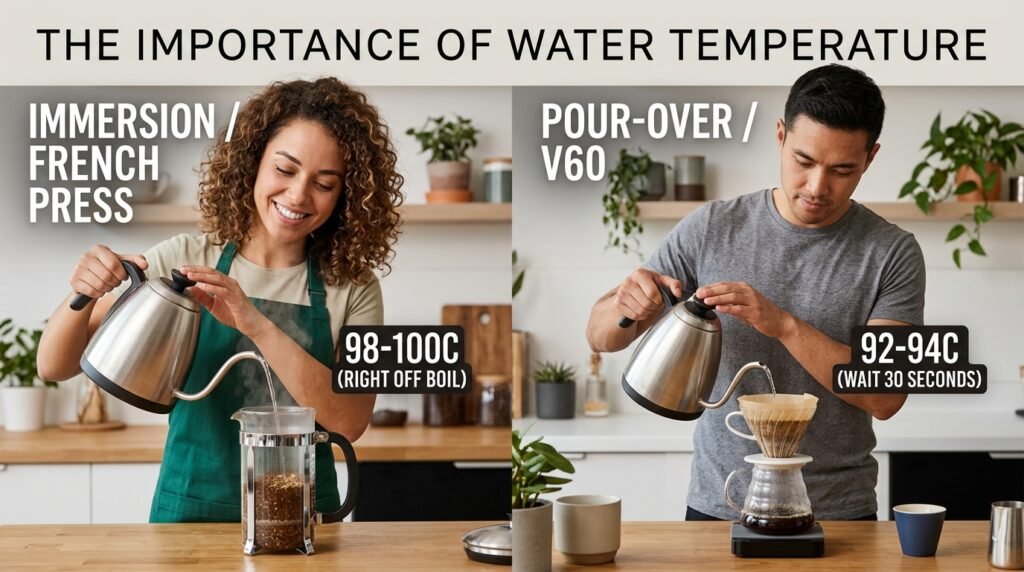
The Importance of Water Temperature
Because immersion is a slower, gentler process, you can afford to use slightly hotter water than you would in a V60.
For a light roast, don’t be afraid to use water right off the boil (98-100C). The thermal mass of the French Press will drop the temperature quickly once it hits the glass. For a darker roast, you might want to wait 30 seconds to let the water drop to about 92-94C to avoid bringing out those harsh, carbonized notes.
Choosing the Right Beans for Immersion
While you can brew anything in a French Press, some coffees shine brighter in this format.
-
Earthy and Chocolatey: Beans from Brazil, Sumatra, or India thrive in the French Press. The immersion method highlights their natural sweetness and spicy undertones.
-
Complex and Fruity: If you have a natural-processed coffee, the French Press will turn it into a “fruit bomb.” The lack of a paper filter means the heavy fruit aromatics are preserved in their entirety.
The only coffees that sometimes struggle in a French Press are the ultra-delicate, tea-like washed Ethiopians. These often benefit from the “stripping” effect of a paper filter to highlight their floral clarity. But even then, a “modern” French Press technique can yield surprising results.
The Ritual of Patience
In today’s world, we are obsessed with “instant.” We want our coffee in 60 seconds. The French Press is a direct challenge to that mindset. It tells you: “Wait. Breathe. It will be ready when it’s ready.”
The 10-minute total brew time of the modern technique is a perfect window for a morning meditation, reading a few pages of a book, or simply watching the steam rise. By the time the coffee is ready to pour, it has cooled to the perfect drinking temperature (around 60C), which, as we know, is when our taste buds are most sensitive to sweetness.

Troubleshooting Your French Press
-
It’s too bitter: Your water was too hot, or you let it sit for 20 minutes before pouring. Pour the coffee into a separate carafe once it’s done brewing to stop the extraction.
-
It’s “sandy”: Your grind is too fine, or you are plunging too aggressively. Be gentle!
-
It’s weak and watery: You didn’t use enough coffee. Try a ratio of 1:15 (e.g., 30g of coffee to 450g of water).
Summary: The French Press Master Checklist
| Step | The Key Factor | Why It Matters |
| Grind Size | Extra Coarse (Sea Salt). | Prevents bitterness and silt. |
| Ratio | 1:12 to 1:15. | Maximizes the “creamy” mouthfeel. |
| Temperature | 94C – 100C. | Provides enough energy for immersion. |
| The Wait | 4 mins (Brew) + 5 mins (Settling). | Ensures a clean, sediment-free cup. |
| Clean-up | Disassemble the mesh. | Prevents rancid oil build-up. |
Final Thoughts
The French Press is a classic for a reason. It is the most honest way to drink coffee. It doesn’t hide behind filters or high-pressure pumps. It is just the bean, the water, and time.
If you’ve given up on the French Press in the past, I encourage you to try the “wait and scoop” method. It will completely change your perspective on what this glass carafe is capable of. It turns a “muddy” drink into a sophisticated, full-bodied experience that warms you from the inside out.
Coffee culture isn’t always about the newest gadget or the most complex technique. Sometimes, it’s about going back to a classic and applying a bit of modern science to make it shine.
So, find that dusty French Press in the back of your cupboard, give it a good scrub, and prepare yourself for the richest cup of coffee you’ve had all year.
Happy brewing, and remember: good things come to those who wait!

Marcelo Clark combines professional industry experience with a passion for democratizing coffee knowledge. Specialist in extraction techniques and an advocate for single-origin beans, Marcelo uses this space to teach beginners how to appreciate the subtle notes of a well-crafted brew. His goal is to make learning about methods and origins simple, relevant, and inspiring for every reader’s daily routine.