
If you are a coffee lover looking to improve your daily cup, you probably have a wishlist. Maybe you are eyeing a shiny Italian espresso machine, a precision temperature-controlled kettle, or a high-end ceramic dripper. We all love beautiful gear.
But I am going to tell you something that might save you hundreds, if not thousands, of dollars: The most important piece of equipment you will ever own is your grinder.
In the world of specialty coffee, we often say that the brewer is just the “delivery system.” The real work happens before the water even touches the coffee. If your grind is inconsistent, it doesn’t matter if you have a $5,000 espresso machine or the world’s most expensive beans—your coffee will taste mediocre at best.
Understanding the mechanics of grinding is the ultimate “level up” in your coffee journey. It is the difference between guessing and knowing. This manifesto will explain why the grinder is the heart of the kitchen and how to choose the right one to finally unlock the flavors you’ve been reading about on those coffee bags.
1. The Physics of Surface Area
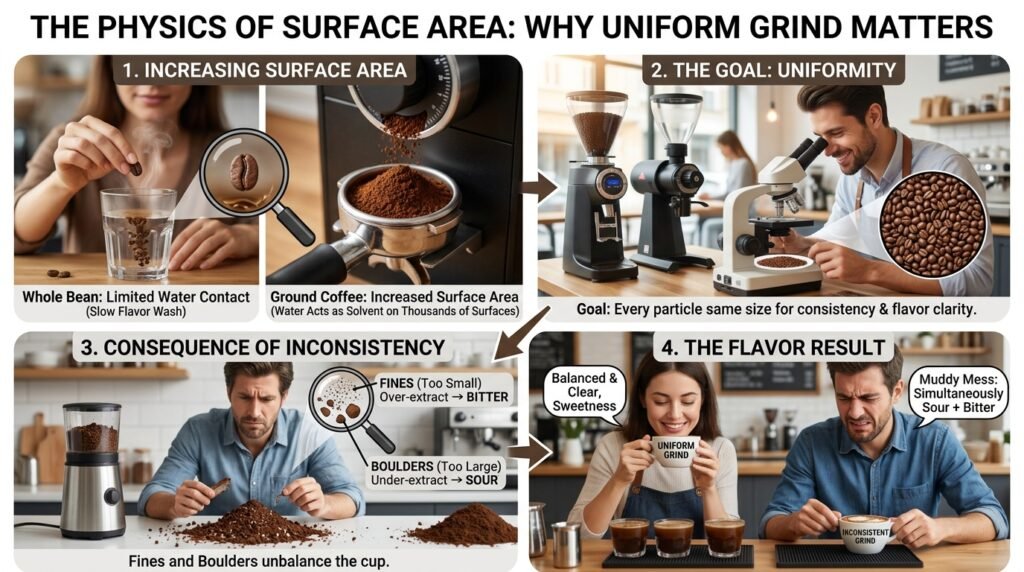
To understand why the grinder is king, we have to look at the science of extraction. When we brew coffee, we are essentially using water as a solvent to wash flavors out of the roasted bean.
If you threw a whole coffee bean into hot water, it would take hours to extract any flavor because the water can only touch the outside surface. By grinding the coffee, we increase the surface area by thousands of times.
The goal of a great grinder is uniformity. You want every single particle of coffee to be exactly the same size.
-
If some particles are too small (fines), they will over-extract and turn bitter.
-
If some particles are too large (boulders), they will under-extract and turn sour.
When you have a mix of both, you get a cup that is simultaneously sour and bitter—a muddy mess that lacks clarity. This is the primary reason why The Chemistry of Extraction: Balancing Acid, Sweet, and Bitter is so difficult to master with a cheap grinder.
2. Blade vs. Burr: The Great Divide
If you are still using a blade grinder (the ones that look like a little blender), it is time for an intervention.
Blade grinders do not actually “grind” coffee; they “shatter” it. Imagine trying to cut a carrot into perfect cubes using a lawnmower. That is what a blade grinder does to your beans. You end up with a mixture of dust and chunks.
Burr grinders work differently. They use two abrasive surfaces (burrs) that sit at a precise distance from each other. The coffee is crushed between them, and a particle can only exit the grinder once it is small enough to fit through the gap. This ensures that the size of the grounds is consistent.
Whether you are Mastering the Hario V60: The Art and Physics of the Perfect Pour-Over or making a quick French Press, a burr grinder is the non-negotiable entry fee to the world of specialty coffee.
3. The Myth of the “Expensive Machine”
Many beginners make the mistake of buying a high-end espresso machine and pairing it with a cheap, entry-level grinder. This is like buying a Ferrari and putting wooden wheels on it.
Espresso is particularly sensitive to grind size. A difference of just a few microns can change the flavor of your shot from “sweet and syrupy” to “salty and thin.”
A high-quality grinder allows for “stepless” adjustments, meaning you can make tiny, microscopic changes to the distance between the burrs. This level of precision is what allows you to “dial in” a coffee, finding the exact point where the acidity and sweetness are perfectly balanced. If your grinder isn’t capable of this, you will spend your life fighting your machine rather than enjoying your coffee.
4. Heat and Volatility: The Science of Freshness
Grinding coffee is a violent process. It creates friction, and friction creates heat.
Low-quality grinders often have small motors that have to work very hard, or dull burrs that create a lot of friction. This heat is the enemy of flavor. As the beans heat up during the grinding process, they begin to release their volatile aromatic oils prematurely. By the time the coffee hits your mug, half of the flavor has already evaporated into the air of your kitchen.
Professional-grade grinders use large, sharp burrs (often 64mm or larger) and powerful motors that spin at lower speeds. This keeps the coffee cool, preserving the “Identity” of the bean that we discuss when Decoding Labels to Find Your Perfect Beans.
5. Stepped vs. Stepless Grinders
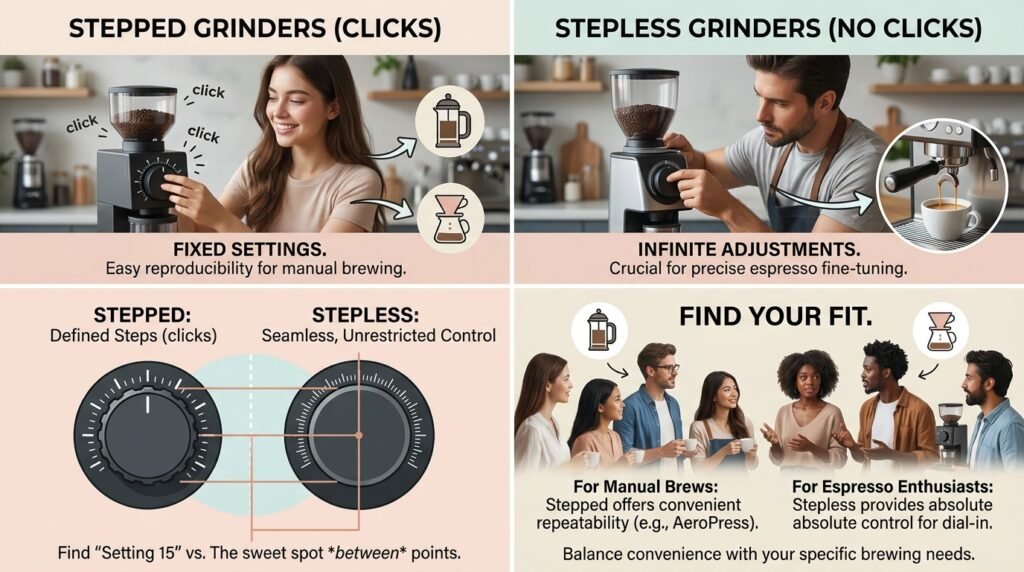
When you go shopping for a grinder, you will encounter these two terms.
-
Stepped Grinders: These have “clicks.” You turn a dial and it clicks into place. This is great for manual brewing (V60, French Press, AeroPress) because it’s easy to remember that “Setting 15” is perfect for your pour-over.
-
Stepless Grinders: These have no clicks. You can turn the dial infinitely. This is essential for espresso, where the “perfect” setting might be exactly halfway between two clicks on a stepped grinder.
For most home users who do a bit of everything, a high-quality stepped grinder is the best balance of convenience and precision. But if you are an espresso purist, stepless is the only way to go.
6. Retention: The Hidden Enemy
Have you ever noticed that the first shot of coffee in the morning tastes a bit “stale” or “flat”? That is often due to retention.
Inside every grinder, there are nooks and crannies where a small amount of ground coffee gets trapped. If your grinder has 5 grams of retention, that means every time you grind fresh beans, you are getting 5 grams of “old” coffee from yesterday (or last week) mixed in.
The best modern grinders are designed for “Single Dosing” and “Zero Retention.” They ensure that every gram of coffee you put in comes back out immediately. This is not just about flavor; it’s about waste. If you have a high-retention grinder, you have to “purge” several grams of coffee every morning to get to the fresh stuff—which is essentially throwing money in the trash.
7. Manual vs. Electric: The Budget Hack
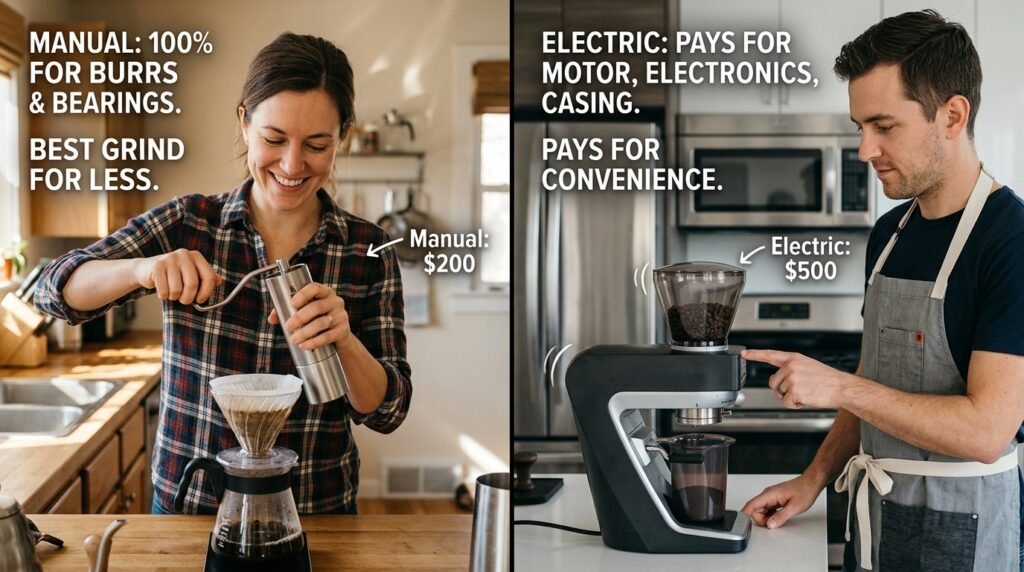
If you want the absolute best grind quality for the lowest price, buy a manual hand grinder.
In an electric grinder, a large portion of the price goes toward the motor, the wiring, the casing, and the electronics. In a manual grinder, almost 100% of the price goes toward the burrs and the bearings.
A $200 hand grinder will often produce a more consistent grind than a $500 electric grinder. Plus, modern high-end hand grinders are incredibly efficient—you can grind a dose for a pour-over in less than 30 seconds with very little effort. It’s also quieter, which your family will appreciate at 6:00 AM.
8. Maintenance: Keeping the Engine Clean
Like any precision tool, a grinder needs care. Coffee beans are oily. Over time, these oils coat the burrs and go rancid. This creates a “stale” background flavor that can ruin even the best beans.
Every few weeks, you should clean your burrs. This can be done with specialized cleaning tablets (which you simply grind through the machine) or by disassembling the grinder and using a small brush to remove the buildup.
Keeping your burrs clean and sharp is the most effective “free” way to improve your coffee quality. If you haven’t cleaned your grinder in six months, you are basically drinking a little bit of rotten oil with every cup.
Summary: The Grinder Buyer’s Guide
| Feature | What to Look For | Why It Matters |
| Burr Type | Conical or Flat Stainless Steel. | Consistency and durability. |
| Adjustment | Micro-steps or Stepless. | Precision for “dialing in” flavor. |
| Retention | Low or Zero Retention. | Ensures every cup is 100% fresh. |
| Build Quality | Metal internals over plastic. | Longevity and heat management. |
| Speed | Low RPM or Large Burrs. | Prevents overheating the delicate oils. |
Final Thoughts
We often focus on the “sexy” parts of coffee: the latte art, the beautiful glass carafes, or the exotic origins. But the grinder is the unheralded hero of the kitchen. It is the gatekeeper of flavor.
If you are currently struggling with coffee that tastes “okay” but never “great,” I encourage you to look at your grinder. Is it producing uniform particles? Is it clean? Is it shattering your beans or grinding them with precision?
Investing in a high-quality burr grinder is the single biggest “win” you can achieve in your coffee journey. It turns brewing from a game of chance into a repeatable science. It honors the work of the farmer and the roaster by allowing their hard work to actually reach your taste buds.
Stop blaming your brewer. Stop blaming your water. Give your beans the grind they deserve, and they will reward you with a world of flavor you never knew existed.
Happy grinding, and may your particles always be uniform!

Marcelo Clark combines professional industry experience with a passion for democratizing coffee knowledge. Specialist in extraction techniques and an advocate for single-origin beans, Marcelo uses this space to teach beginners how to appreciate the subtle notes of a well-crafted brew. His goal is to make learning about methods and origins simple, relevant, and inspiring for every reader’s daily routine.