
In the modern specialty coffee industry, we are obsessed with protection. We use vacuum-sealed bags, climate-controlled shipping containers, and airtight silos to ensure that not a single drop of moisture or a gust of humid air touches our precious green beans. We want them pristine, green, and vibrant.
But there is one coffee in the world that spits in the face of these modern rules. It is a coffee that is intentionally exposed to the elements. It is a coffee that is aged, swollen, and faded to a ghostly pale yellow before it ever touches a roaster.
This is Monsoon Malabar.
Born on the Malabar Coast of Karnataka and Kerala in India, this coffee is a “historical accident” that became a legendary flavor profile. It tastes like nothing else on Earth—low in acid, heavy in body, and packed with notes of spice, tobacco, and salted caramel.
In this guide, we are going to explore the maritime history of the Monsoon process, the unique chemistry of “weathered” beans, and why this “ugly” bean is a secret weapon for espresso lovers worldwide.
1. The Historical Accident: Sailing the Cape of Good Hope
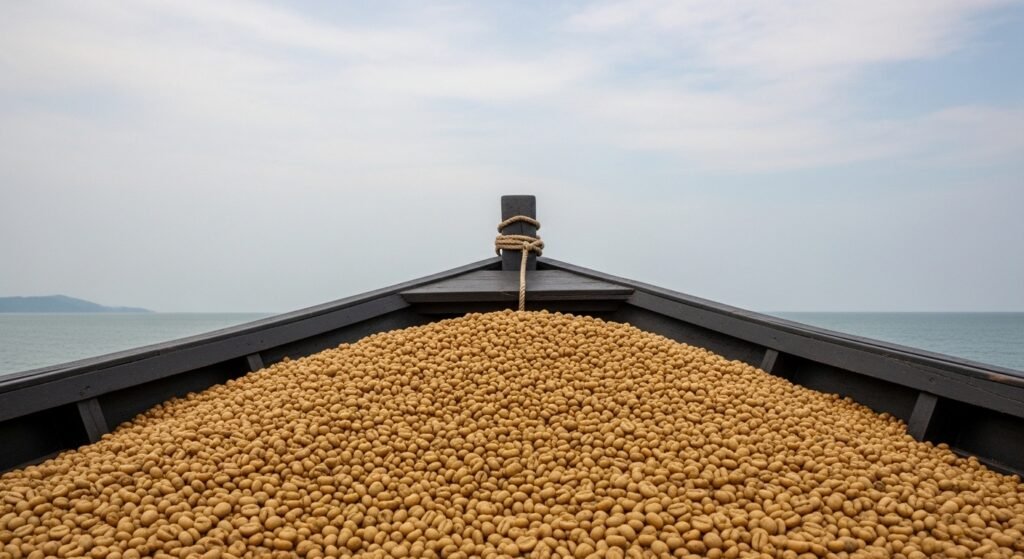
The story of Monsoon Malabar begins in the 18th and 19th centuries, long before the invention of the steamship or the Suez Canal. Back then, Indian coffee was shipped to Europe in wooden sailing vessels.
The journey around the Cape of Good Hope took six months. During this time, the coffee was stored in the damp, humid holds of the ships. The beans were constantly exposed to the high humidity and salty sea winds of the monsoon season.
By the time the ships arrived in ports like London or Amsterdam, the coffee had physically changed. The moisture had caused the beans to swell in size, and the humidity had stripped away their natural acidity. The beans turned from deep green to a pale, golden straw color.
When Europeans finally moved to faster steamships and started using the Suez Canal, the journey time was cut in half. The coffee arrived “fresh” and green—and the European public hated it. They had grown so accustomed to the mellow, spicy, and weathered taste of the “accidental” coffee that they demanded the old flavor back. To satisfy them, Indian producers had to find a way to replicate the conditions of a six-month sea voyage on dry land.
2. The Monsooning Process: Mimicking the Sea
Today, Monsoon Malabar is a protected geographical indication (PGI) in India. It isn’t just a type of bean; it is a specific process that can only happen on the Malabar Coast between June and September.
During these months, the southwest monsoon brings constant rain and high-intensity humid winds. The process works like this:
-
Natural Processing: The coffee is first processed as “Cherry” (sun-dried) to reach a stable moisture level.
-
The Monsoon Sheds: The beans are spread out on the floors of large, open-walled warehouses on the coast.
-
Raking and Turning: Workers constantly rake and turn the beans by hand to ensure they are evenly exposed to the moisture-laden winds.
-
Bagging and Re-bagging: The coffee is packed into jute bags and stacked, then unpacked and spread out again. This “breathing” cycle allows the beans to absorb moisture up to a certain point without rotting.
This process lasts for 12 to 16 weeks. By the end, the beans have nearly doubled in size and lost about 30% of their density. They are literally “blown up” by the monsoon.
3. The Chemistry of “Dead” Acidity
From a scientific perspective, what happens during monsooning is a form of controlled degradation.
In The Chemistry of Extraction: Balancing Acid, Sweet, and Bitter, we usually talk about preserving acidity. However, the monsoon process does the opposite. The constant cycle of absorbing and releasing moisture breaks down the chlorogenic acids that give coffee its “brightness.”
The result is a bean with a pH level that is much closer to neutral than almost any other coffee. This makes it incredibly easy on the stomach. But more importantly, it changes the flavor profile entirely. Without the sharp acidity to distract the tongue, the earthy, spicy, and “musty” (in a good way) notes come to the forefront.
This is a perfect example of why The Science of Coffee Aromas: How Your Nose Determines Flavor is so subjective; while some might find the “aged” aroma of Monsoon Malabar strange, others find it provides a nostalgic, complex depth that fresh coffees lack.
4. The Espresso Secret: Crema and Body
If you talk to an Italian master roaster, they will often tell you that their “secret” espresso blend contains a small percentage of Monsoon Malabar.
Why? Because of the physics of the bean.
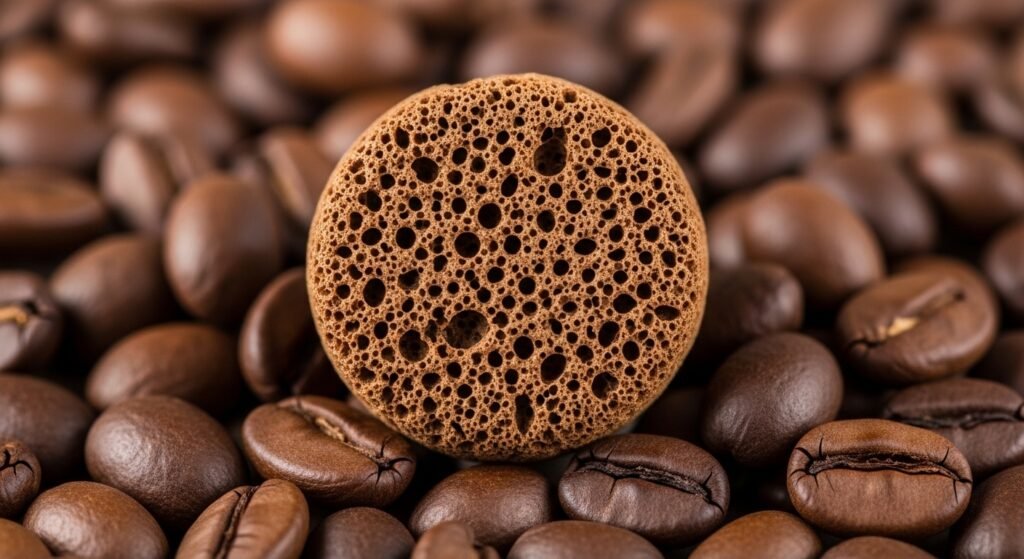
Since the beans are so porous and have a very low density, they behave differently under the 9 bars of pressure in an espresso machine. They produce an incredible amount of crema. The crema from a Monsoon Malabar blend is thick, persistent, and has a beautiful tiger-striping. Furthermore, the low acidity ensures that the espresso doesn’t taste “sour,” even if the extraction isn’t perfect. It contributes a massive, syrupy mouthfeel that is a core part of The Science of Coffee Body: What Creates That Syrupy Mouthfeel?.
5. Roasting the Ghost: The Challenge of Pale Beans
Roasting Monsoon Malabar is a challenge for any professional. As we discussed in our guide to The Science of Coffee Freshness: Why ‘Degassing’ is a Roaster’s Secret Weapon, roasters usually rely on color changes to know when a bean is done.
However, Monsoon Malabar starts off pale yellow. It doesn’t go through the same “green to yellow” transition. Because it is so low in density, it also absorbs heat very quickly. If you roast it like a dense Ethiopian bean, you will burn the outside while the inside remains underdeveloped.
Roasters have to use a “gentle” heat profile. The goal is to highlight the woodsy, spicy notes (cinnamon, clove, black pepper) without turning the coffee into something that tastes like charcoal. When done right, it smells like a spice market in Old Delhi.
6. Flavor Profile: What Does the Wind Taste Like?
Monsoon Malabar is the “love it or hate it” coffee of the specialty world. It does not have the “cleanliness” of a washed Colombian or the “fruitiness” of a Kenyan. Instead, it offers a savory, “old world” experience.
-
Primary Notes: Earth, Tobacco, Leather, Dark Chocolate.
-
Secondary Notes: Black Pepper, Nutmeg, Salted Caramel.
-
Acidity: Near zero. It is soft and mellow.
-
Mouthfeel: Heavy, coating, and oily.
For people who find modern “third-wave” light roasts too sour or tea-like, Monsoon Malabar is often a sanctuary. It is a return to a style of coffee that feels substantial and grounding.
7. The Myth of the “Musty” Bean
One of the biggest criticisms of Monsoon Malabar is that it can sometimes taste “baggy” or “musty.” Because the beans are exposed to high humidity, there is always a risk of mold if the process isn’t managed perfectly.
This is why the PGI certification is so important. Authentic Monsoon Malabar is processed in facilities that have been doing this for generations. They know exactly how much airflow is needed to keep the beans “weathering” without allowing harmful fungi to grow.
When you buy a high-quality Monsoon Malabar, that “earthy” taste shouldn’t be dirty; it should be clean, forest-like, and spicy. It’s the difference between the smell of a damp basement and the smell of a forest after a summer rain.
8. Brewing the Monsoon: Methods and Tips
Because this coffee is so low in acid and high in body, you have to be careful not to “over-mute” it during brewing.
The French Press:
This is perhaps the best way to enjoy a single-origin Monsoon Malabar. The metal filter allows the heavy oils to pass through, emphasizing the syrupy body. Use a slightly lower water temperature (around 90 degrees Celsius) to keep the earthy notes sweet rather than bitter.
The Espresso Blend:
Try mixing 20% Monsoon Malabar with 80% of a bright Brazilian or Central American coffee. The Malabar will act as the “anchor,” providing the body and the crema, while the other beans provide the top-note sweetness.
The Moka Pot:
This is a match made in heaven. The intense, pressurized extraction of the Moka pot brings out the tobacco and chocolate notes of the Malabar perfectly. It results in a cup that feels incredibly “Italian” in its soul.
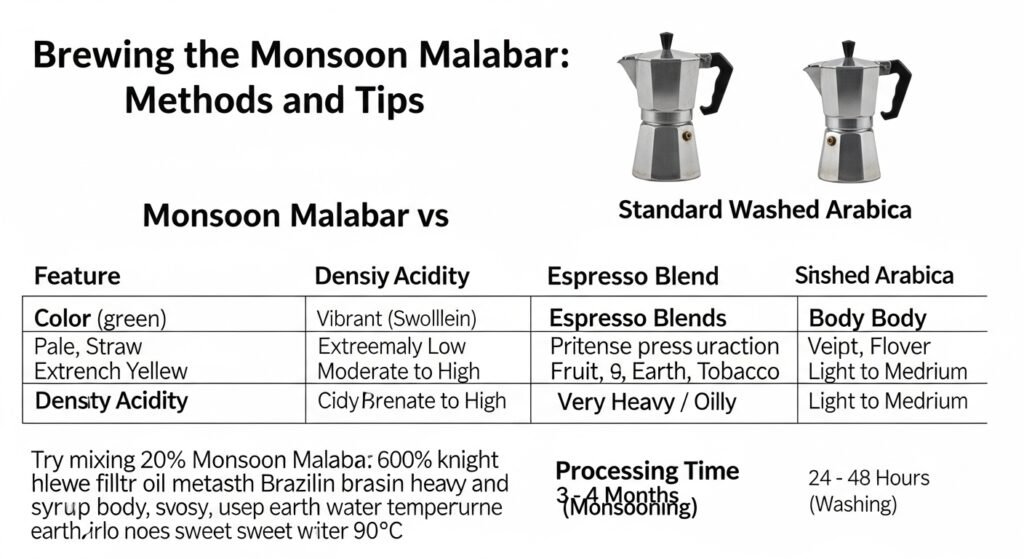
Summary: Monsoon Malabar vs. Standard Arabica
| Feature | Monsoon Malabar | Standard Washed Arabica |
| Color (Green) | Pale Yellow / Straw | Vibrant Green / Blue-Green |
| Density | Low (Swollen) | High (Compact) |
| Acidity | Extremely Low | Moderate to High |
| Body | Very Heavy / Oily | Light to Medium |
| Primary Flavors | Spice, Earth, Tobacco | Fruit, Floral, Sugar |
| Processing Time | 3 – 4 Months (Monsooning) | 24 – 48 Hours (Washing) |
Final Thoughts
Monsoon Malabar is a reminder that in the world of coffee, “perfect” is subjective. While the rest of the industry is racing toward more clarity, more acidity, and more protection, the Malabar Coast continues to embrace the chaos of the weather.
It is a coffee that carries the history of the Indian Ocean in its cells. It tells a story of long voyages, wooden ships, and the incredible power of the monsoon winds. Whether you use it to add “muscle” to your espresso blend or enjoy its spicy earthiness in a French Press, you are participating in one of the oldest traditions in the coffee trade.
Don’t be afraid of the pale, swollen bean. It might not look like the specialty coffee you’re used to, but it has a soul that has survived centuries of change.
Happy (spicy) brewing!

Marcelo Clark combines professional industry experience with a passion for democratizing coffee knowledge. Specialist in extraction techniques and an advocate for single-origin beans, Marcelo uses this space to teach beginners how to appreciate the subtle notes of a well-crafted brew. His goal is to make learning about methods and origins simple, relevant, and inspiring for every reader’s daily routine.