
There is a specific moment in every coffee lover’s life when the “magic” happens. Maybe it was a silky Flat White at a hidden alleyway cafe in Melbourne, or a crystalline pour-over in a minimalist shop in Tokyo. Suddenly, the coffee you’ve been making at home for years—the pre-ground stuff from the tin—just doesn’t cut it anymore.
You realize that coffee isn’t just a caffeine delivery system; it’s a craft.
In the last few years, we have seen a massive explosion in the “Home Barista” movement. Driven by a desire for better quality, the rise of social media “coffee-gramming,” and the availability of professional-grade gear for the home, thousands of people are reclaiming their mornings. They are turning small corners of their kitchens into specialized “stations” dedicated to the pursuit of the perfect cup.
But building a coffee station can be overwhelming. Do you need a $2,000 espresso machine right away? Is a digital scale really necessary? How do you organize a space that is both functional and beautiful?
In this guide, we are going to walk you through the process of building your first coffee station, from the “Essential Trio” of gear to the ergonomic layout that will make your morning ritual feel like a meditative retreat rather than a chore.
1. The Philosophy of the Station: Ritual Over Routine
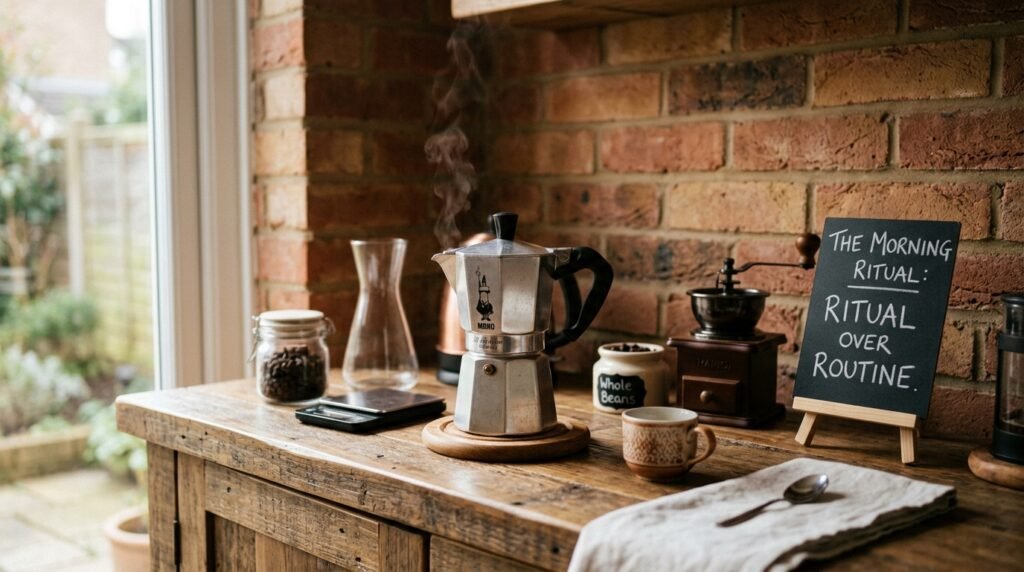
Before we talk about gear, we have to talk about mindset. A coffee station isn’t just a place to store a machine; it’s a dedicated space for a ritual. In our fast-paced world, the morning coffee is often the only ten minutes we have to ourselves. By creating a dedicated station, you are signaling to your brain that this time is different. It’s a time for precision, for aroma, and for presence.
This is why we focus so much on The Moka Pot Ritual: Mastering Italy’s Iconic Stovetop Tool. Even with simple equipment, the act of setting up your station and following a process creates a level of satisfaction that no automatic “pod” machine can ever replicate.
2. Phase One: The Essential Trio (The Foundation)
If you are starting from scratch, don’t buy an espresso machine first. To make great coffee at home, you only need three things. If you get these right, you will already be making better coffee than 90% of the cafes on the high street.
A. The Grinder (The Heart):
As we have shouted from the rooftops in The Science of the Burr: Why Blade Grinders are Killing Your Coffee, the grinder is the most important tool you will own. If your grind isn’t uniform, your extraction will be chaotic. For a first station, a high-quality manual hand grinder is the best value for money, but if you prefer electric, look for an entry-level conical burr grinder.
B. The Scale (The Brain):
Coffee is a game of ratios. If you use “two scoops” of coffee today and “three spoons” tomorrow, your coffee will never taste the same twice. A simple digital scale that measures to 0.1g allows you to be consistent. Consistency is the only way to learn what you actually like.
C. The Brewer (The Vessel):
Choose one method and master it before moving on. For beginners, we often recommend the AeroPress or a classic French Press because they are forgiving and produce a heavy, satisfying body. If you prefer clarity, a plastic V60 is an inexpensive and world-class way to start.
3. Ergonomics: Designing for the “Morning Fog”
When you are designing your station, you need to think about the “Workflow.” You want to move from left to right (or right to left) in a logical sequence.
-
The “Dirty” Zone: This is where your scale and grinder live. This is where the “mess” happens—the coffee dust and the bean chaff.
-
The “Wet” Zone: This is where your kettle and brewer sit. It should be near a water source or your filtered water pitcher.
-
The “Clean” Zone: This is where your finished mugs and spoons live.
By separating these zones, you prevent your station from becoming a cluttered mess of wet grounds and dry dust. Remember, a clean station leads to a clean-tasting cup. This organization is vital when you are Calibrating Your Espresso: The Dialing-In Process, as a cluttered workspace leads to skipped steps and inconsistent shots.
4. Lighting and Aesthetics: Making it a Destination
Your coffee station should be a place you want to go.
-
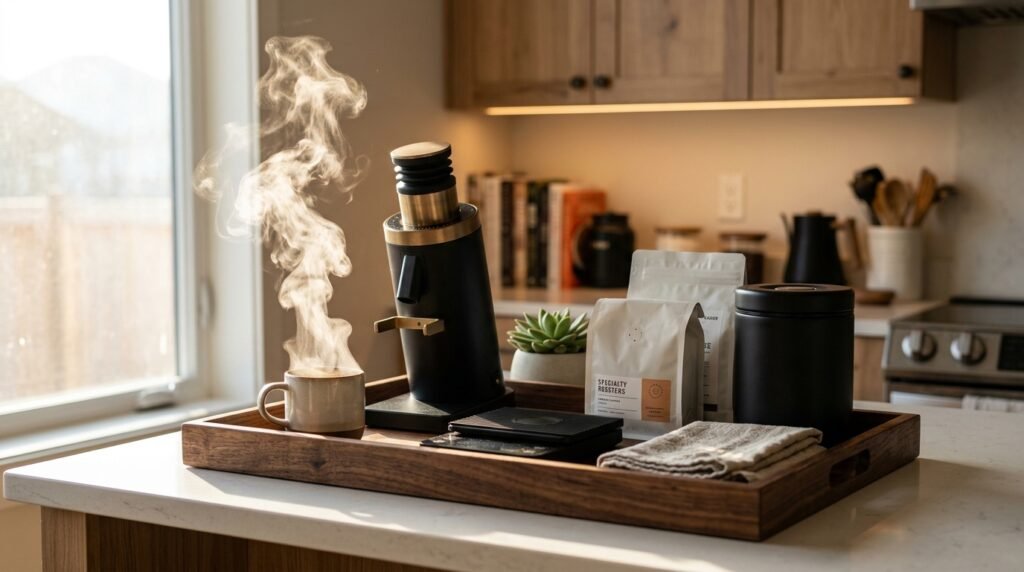
Lighting: If possible, place your station near a window. There is something magical about the sun hitting the steam rising from a fresh brew. If your kitchen is dark, add a small LED strip under the cabinets to illuminate your workspace.
-
Materials: Use a tray to “zone” the area. A wooden or marble tray can hold your grinder, scale, and beans, making the station feel like a deliberate part of the decor rather than just more kitchen clutter.
-
Storage: Keep your beans in their original bags (if they have a valve) or in specialized vacuum canisters. Never store your coffee in clear glass jars on the counter—light is the enemy of flavor.
5. The Water Station: The Forgotten Ingredient
You cannot make good coffee with bad water. If your coffee station is far from the sink, consider keeping a dedicated water pitcher with a filter right there on the counter.
As we’ve discussed in our guides on water chemistry, minerals like Magnesium and Calcium are the “magnets” that pull flavor out of the beans. If your tap water is too hard or too soft, your coffee station will never reach its full potential. A small dedicated water area with a filter ensures that you are starting every brew with a clean slate.
6. Developing Your “Signature” Workflow
Being a home barista is about finding the “flow” that works for you.
Some people love the manual labor of hand-grinding and the slow, precise pouring of a gooseneck kettle. Others prefer the industrial precision of a high-end electric setup.
The “Rise of the Home Barista” isn’t about having the most expensive gear; it’s about the knowledge of extraction. Once you understand how grind size, temperature, and time interact, you can make a better cup of coffee on a $20 AeroPress than someone who has a $5,000 espresso machine but doesn’t know how to use it.
7. The Evolution: What Comes Next?
Once you have mastered the basics, the home barista journey usually follows a predictable (and expensive) path:
-
Level 1: The Discovery. You buy a burr grinder and a scale. Your coffee immediately improves.
-
Level 2: The Exploration. You start buying single-origin beans from different countries. You start noticing the difference between a “Washed” and a “Natural” process.
-
Level 3: The Espresso Rabbit Hole. You decide you want to make Flat Whites at home. You start looking at boilers, pressure gauges, and bottomless portafilters.
-
Level 4: The Science Phase. You start measuring the TDS (Total Dissolved Solids) of your coffee and experimenting with custom water recipes.
The beauty of the home barista movement is that there is no “end.” There is always a new bean to try, a new technique to master, or a new piece of gear that promises a 1% improvement in flavor.

8. Maintenance: Respecting the Tools
A true barista knows that their tools are only as good as their cleanliness.
Build a “Cleaning Kit” for your station:
-
A small brush: For sweeping coffee grounds off your scale and grinder.
-
A microfiber cloth: For wiping up water spills and keeping your kettle shiny.
-
Cleaning Tablets: For deep-cleaning your brewer or espresso machine once a month.
If your station is dirty, your coffee will eventually taste “off.” Old, rancid coffee oils build up quickly, and they are the number one cause of bitterness in home-brewed coffee. Treat your station with the same respect a professional chef treats their knives.
Summary: Building Your Station (Phase by Phase)
| Phase | Core Equipment | Goal |
| Phase 1: The Starter | Manual Grinder, Scale, AeroPress | Consistency and Quality. |
| Phase 2: The Enthusiast | Electric Burr Grinder, Gooseneck Kettle, V60 | Precision and Exploration. |
| Phase 3: The Pro-Sumter | Entry-level Espresso Machine, Milk Pitcher | Mastering Texture and Intensity. |
| Phase 4: The Lab | Water Filtration System, Refractometer | Technical Perfection and Nuance. |
Final Thoughts
The “Rise of the Home Barista” is a return to a more intentional way of living. It’s about taking a commodity—coffee—and turning it into an experience.
When you build your first coffee station, you aren’t just rearranging your kitchen. You are creating a space for curiosity, for learning, and for a better start to your day. You are joining a global community of people who believe that a great cup of coffee is worth the extra five minutes of effort.
Start small. Focus on the grinder and the scale. Learn the rules of extraction, and then have fun breaking them. Your kitchen is now your laboratory, and the best cup of coffee you’ve ever had is probably the one you’re about to make yourself.
Happy brewing, and welcome to the world of the home barista!

Marcelo Clark combines professional industry experience with a passion for democratizing coffee knowledge. Specialist in extraction techniques and an advocate for single-origin beans, Marcelo uses this space to teach beginners how to appreciate the subtle notes of a well-crafted brew. His goal is to make learning about methods and origins simple, relevant, and inspiring for every reader’s daily routine.