
You’ve invested in the best gear. You have the precision burr grinder, the goose-neck kettle with digital temperature control, and you’re buying fresh, light-roasted beans from the best roasters in the world. But somehow, your coffee still tastes… flat. Or maybe it has a harsh, metallic bite that no amount of technique can fix.
You check your grind size. You check your brew time. Everything is perfect. So, what’s left?
The answer is likely coming straight out of your faucet. Water is the “silent partner” in your morning ritual. While we focus on the coffee beans, we often forget that coffee is essentially just flavored water. If that water is packed with chlorine, heavy minerals, or has the wrong pH balance, it doesn’t matter how good your beans are—the chemistry of extraction will fail.
In this guide, we are going to dive into the chemistry of H2O, explain why “pure” water is actually bad for coffee, and show you how to choose the right filtration system to finally unlock the flavors you’ve been paying for.
1. The Chemistry of Extraction: Water as a Solvent
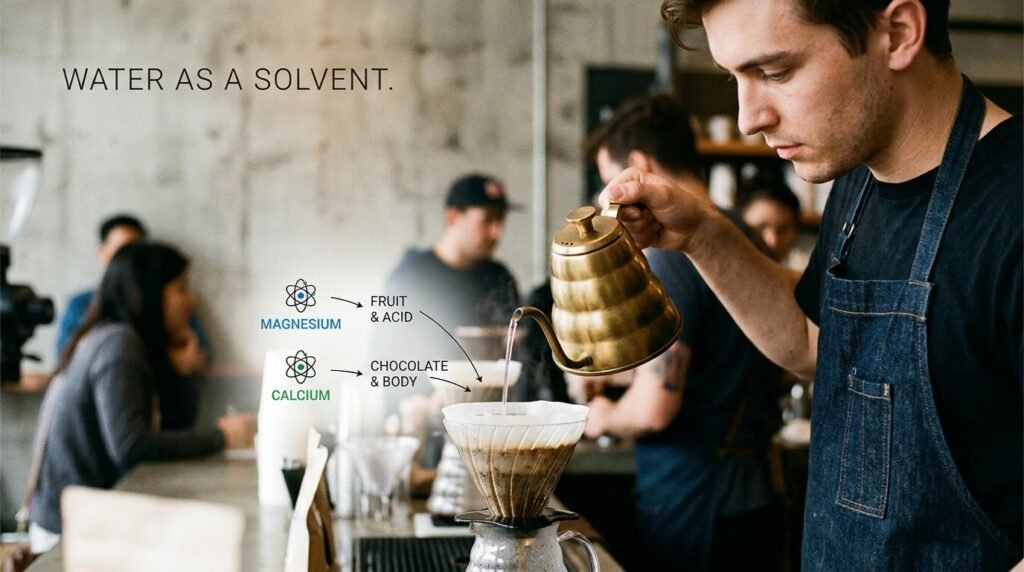
To understand why water quality matters, we have to look at water as a solvent. When hot water touches coffee grounds, it acts like a magnet, pulling out oils, acids, and sugars.
However, water isn’t just “empty” space. It is filled with minerals, primarily Calcium and Magnesium. * Magnesium is the “heavy lifter.” It is great at pulling out sharp, fruity, and acidic flavors.
-
Calcium is the “balancer.” It helps extract the heavier, chocolatey, and creamy notes.
If your water has too few minerals (like distilled water), it becomes “aggressive” and pulls out everything, including the bitter woody fibers. If it has too many minerals (hard water), there is “no room” left in the water to hold the coffee flavors. This is why The Chemistry of Extraction: Balancing Acid, Sweet, and Bitter is so dependent on what is in your kettle before you even turn it on.
2. Hard Water vs. Soft Water: The Flavor Battlefield
Most of us live in areas with either “Hard” or “Soft” water, and both present unique problems for the home barista.
Hard Water:
This water is high in Calcium Carbonate (limescale). While it might be safe to drink, it is a disaster for coffee. The excess minerals “buffer” the acids in the coffee, turning a vibrant, citrusy Ethiopian bean into a dull, chalky mess. Furthermore, hard water is the number one killer of coffee machines. It leaves behind scale deposits that clog the internal pipes of your espresso machine.
Soft Water:
You might think soft water is better, but it often lacks the Magnesium needed to “grab” the bright flavor molecules. Soft water can lead to a cup that tastes “salty” or flat. If you use a salt-based water softener for your whole house, you are essentially replacing calcium with sodium, which is terrible for the delicate balance of a pour-over. This is a common hurdle when How to Choose the Best Coffee for Each Brewing Method, as some methods are more sensitive to these mineral imbalances than others.
3. The Chlorine Problem: The “Pool” Taste
Cities treat water with chlorine or chloramine to keep it safe from bacteria. While this is great for public health, it is a nightmare for your palate.
Chlorine reacts with the organic compounds in coffee to create “chlorophenols.” Even in tiny amounts, these chemicals produce a medicinal, plastic-like, or “swimming pool” taste. If you can smell chlorine when you turn on your kitchen tap, you are guaranteed to have muted, distorted flavors in your coffee.
A basic carbon filter is usually enough to remove chlorine, but many standard “pitcher” filters don’t handle the mineral balance correctly. This is where specialized coffee filtration comes into play.
4. Different Types of Filters: From Pitchers to Reverse Osmosis
So, how do you fix your water? There are several levels of “filtration,” depending on how deep you want to go into the rabbit hole.
A. Carbon Block Filters (The Basic Pitcher):
Standard Brita-style filters are mostly designed to improve taste and odor by removing chlorine. They are a good first step, but they do very little to change the mineral hardness (TDS) of the water. If you have very hard water, a basic pitcher won’t save your coffee.
B. Ion-Exchange Filters (The Specialized Pitcher):
Filters like Peak Water or ZeroWater are different. They use ion-exchange resins to actually remove or swap minerals. Peak Water, for example, allows you to “dial in” the hardness, giving you the ability to customize your water for the specific roast you are brewing.
C. Reverse Osmosis (RO):
RO systems strip everything out of the water, leaving you with nearly pure H2O. But remember: pure water makes bad coffee. If you use an RO system, you must add minerals back in. This is the “Gold Standard” for high-end cafes, where they strip the water and then use a remineralization cartridge to add back a precise “recipe” of Magnesium and Calcium.
5. The “Water Recipe” Trend: Third Wave Water
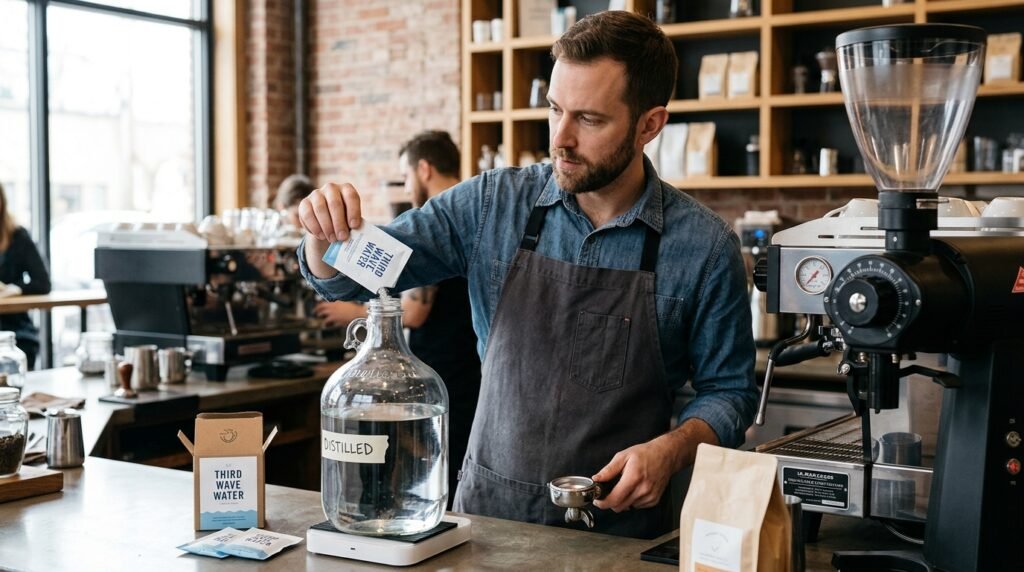
For the ultimate control, many specialty coffee enthusiasts have stopped using tap water altogether. They buy distilled or RO water and add “mineral packets” like Third Wave Water.
These packets contain a scientifically balanced mix of Magnesium Sulfate, Calcium Citrate, and Potassium Bicarbonate. By adding one packet to a gallon of distilled water, you create a “perfect” brewing environment that is consistent every single time.
This level of precision is especially important for Calibrating Your Espresso: The Dialing-In Process. If your water changes day to day, you will never be able to truly “dial in” your grinder because the variable of the water is constantly moving the goalposts.
6. Protecting Your Gear: The Scale Nightmare
Filtration isn’t just about taste; it’s about protecting your investment. Limescale is the “silent killer” of espresso machines and electric kettles.
When hard water is heated, the minerals solidify and stick to the heating elements and the inside of the boiler. This acts as an insulator, making your machine work harder to heat the water and eventually causing the elements to burn out. It also narrows the pipes, leading to poor pressure and inconsistent shots.
By using a filter that addresses Total Hardness, you can extend the life of your equipment by years. If you don’t use a filter, you should be descaling your machine at least once a month, but even descaling is a harsh chemical process that can wear down your machine’s seals over time. Prevention through filtration is always better than the cure.
7. How to Test Your Water at Home
Before you buy an expensive filter, you need to know what you’re fighting.
-
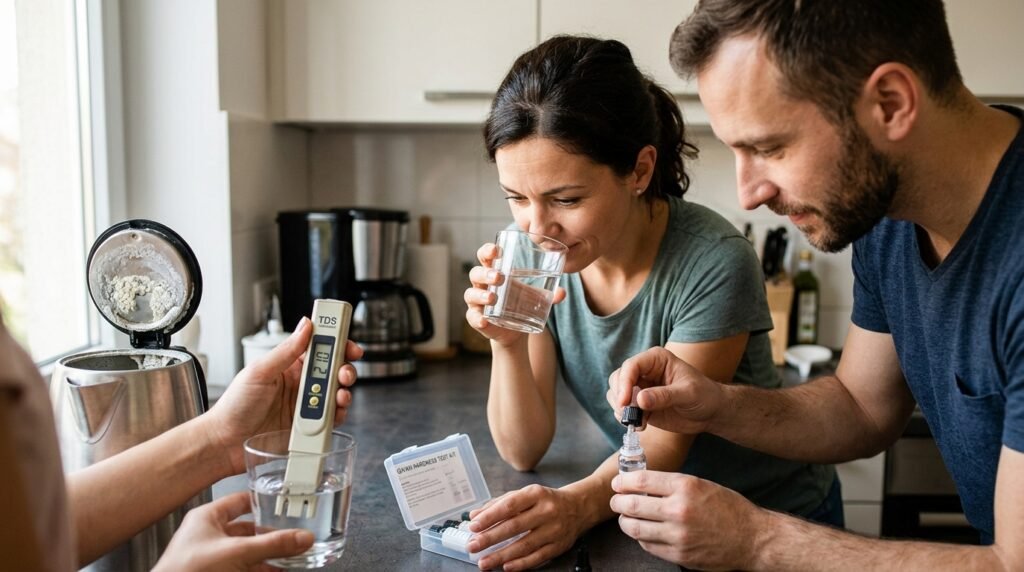
TDS Meter: A cheap Total Dissolved Solids (TDS) meter will tell you the “density” of minerals in your water. For coffee, the Specialty Coffee Association (SCA) recommends a TDS of around 150 mg/L.
-
Drop Tests: These are chemical kits (similar to what you use for a fish tank) that measure GH (General Hardness) and KH (Carbonate Hardness).
-
The Smell Test: If your water smells like a pool, focus on carbon filtration. If your kettle has white crusty buildup, focus on softening.
8. The Impact of pH on Acidity
Finally, we have to talk about pH. Coffee is naturally acidic. Ideally, your brewing water should be neutral (pH 7.0).
If your water is too alkaline (high pH), it will neutralize the delicate fruit acids in the coffee, making it taste “flat” or “earthy.” If your water is too acidic (low pH), it will make the coffee taste sharp, sour, and metallic. Most carbon and ion-exchange filters do a decent job of keeping the pH in the neutral range, but it’s another reason why “raw” tap water is such a gamble.
Summary: Filtration Comparison Table
| Filter Type | Removes Chlorine? | Controls Minerals? | Best For… |
| Basic Pitcher (Brita) | Yes | No | Improving taste in areas with “good” tap water. |
| Specialized Pitcher (Peak) | Yes | Yes | Dialing in specific recipes for pour-over. |
| Reverse Osmosis (RO) | Yes | Yes (Removes all) | High-end espresso machines (Requires re-mineralizing). |
| Mineral Packets | N/A (Use with Distilled) | Yes (Adds them) | Absolute consistency and gear protection. |
| Inline Carbon Filter | Yes | No | Basic plumbing for fridges/cheap brewers. |
Final Thoughts
We often treat water as a “given,” but in the world of specialty coffee, it is a variable that can be mastered. You don’t need to become a chemist to make better coffee, but you do need to acknowledge that 98% of what is in your cup came from your sink.
If you are spending money on high-quality beans and precision gear, don’t let the last mile of the journey be ruined by poor water. Even a simple upgrade to a specialized filter pitcher can be the difference between a “okay” cup and a “transcendental” one.
Stop fighting your tap water and start working with it. Your palate—and your coffee machine—will thank you.
Happy brewing, and may your water always be perfectly balanced!

Marcelo Clark combines professional industry experience with a passion for democratizing coffee knowledge. Specialist in extraction techniques and an advocate for single-origin beans, Marcelo uses this space to teach beginners how to appreciate the subtle notes of a well-crafted brew. His goal is to make learning about methods and origins simple, relevant, and inspiring for every reader’s daily routine.