
If you have ever stood in a high-end specialty cafe and watched a barista prepare a V60 or a Chemex, you might have noticed how focused they look. They aren’t just pouring water; they are watching the stream with the precision of an archer. They hold the kettle at a specific height, move in steady circles, and pause with rhythmic timing.
To the casual observer, it looks like theater. But to a physicist, it is a controlled experiment in fluid dynamics.
In the world of the pour-over, water is your solvent and your kinetic tool. How that water hits the coffee bed—and how fast it moves through it—determines whether your morning cup is a vibrant, balanced masterpiece or a muddy, bitter disappointment.
In this guide, we are going to dive into the “invisible” forces at play in your dripper. We will explore the impact of pouring height, the science of agitation, and why the “gooseneck” kettle isn’t just a stylish accessory, but a vital piece of laboratory equipment.
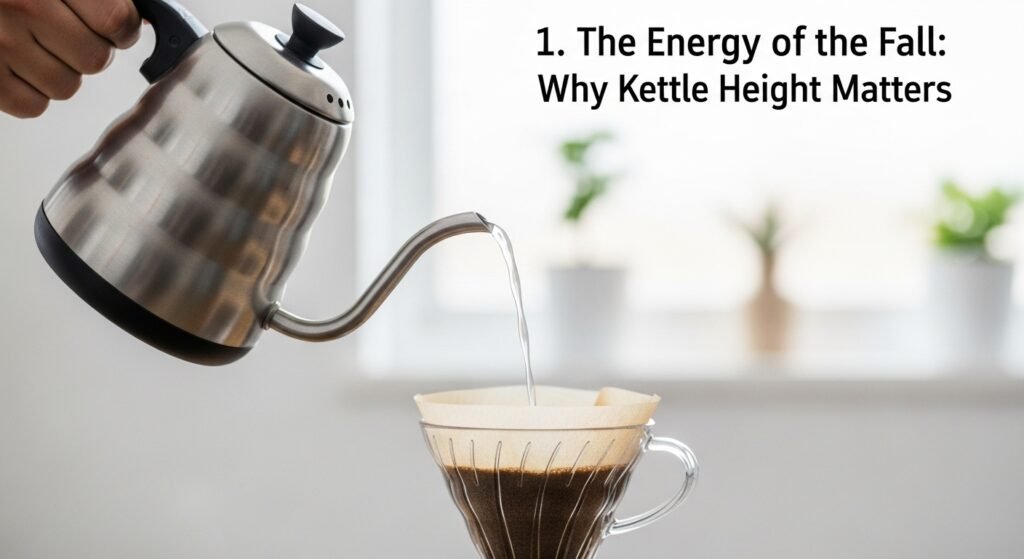
1. The Energy of the Fall: Why Kettle Height Matters
When water leaves the spout of your kettle, it possesses potential energy. As it falls toward the coffee bed, that energy turns into kinetic energy.
The higher you hold the kettle, the faster the water is moving when it hits the coffee. This creates agitation. Agitation is the physical stirring of the coffee grounds by the force of the water. Some agitation is good; it ensures that every single grain of coffee is “washed” by fresh water. However, too much agitation—caused by pouring from too high—can cause the “fines” (the smallest coffee particles) to migrate to the bottom of the filter.
When the fines clog the paper, the water gets stuck, leading to over-extraction. This is why The Science of the Burr: Why Blade Grinders are Killing Your Coffee is so important; if your grind isn’t uniform, even the most perfect pouring height won’t save you from a clogged filter.
2. Flow Rate: The Speed of Flavor
Flow rate is simply the volume of water you pour over a specific period (usually measured in grams per second).
If you pour too fast, the water level in the dripper rises quickly. This creates more “head pressure,” which pushes the water through the coffee bed faster. While this might seem efficient, it often leads to under-extraction. The water doesn’t have enough “contact time” to dissolve the sugars and complex acids.
If you pour too slowly, the water temperature drops significantly before it even hits the coffee. Furthermore, the water might sit too long in the grounds, extracting the heavy, bitter tannins that we usually try to avoid.
Finding the “Sweet Spot” in flow rate is the secret to consistency. Most professional baristas aim for a flow rate of about 5g to 8g of water per second. This is where Calibrating Your Espresso: The Dialing-In Process and pour-over brewing meet; both require you to manage the relationship between time and volume to achieve balance.
3. The Gooseneck Geometry: Laminar vs. Turbulent Flow
Have you ever wondered why we don’t just use a standard tea kettle for pour-overs? The answer lies in the shape of the spout.
A standard kettle spout is wide. When water pours out, it creates turbulent flow—the water is swirling, splashing, and uneven. This makes it impossible to target specific areas of the coffee bed, leading to “channeling,” where water bypasses some grounds and over-extracts others.
A gooseneck kettle is designed to encourage laminar flow. The long, narrow neck restricts the water, causing it to move in a smooth, straight, and predictable line. This allows you to place the water exactly where you want it, ensuring an even “wash” across the entire surface.
This precision is vital for managing The Chemistry of Extraction: Balancing Acid, Sweet, and Bitter. Without a gooseneck, you are essentially gambling with your extraction.
4. The Bloom: Escaping the CO2 Prison
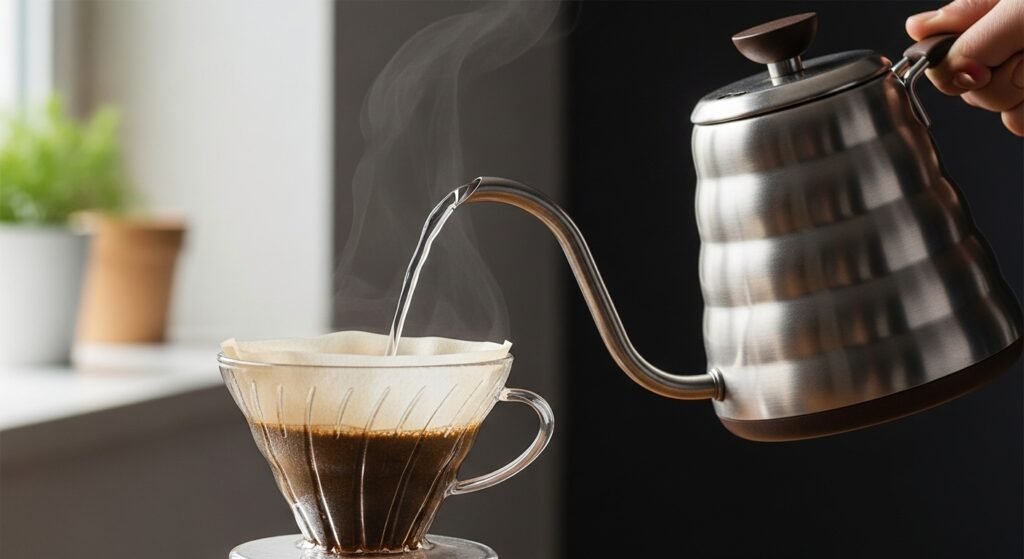
The most dramatic moment of a pour-over is the bloom. This is the initial pour where you add just enough water to wet the grounds and then wait for 30 to 45 seconds.
As the water hits the dry coffee, the grounds appear to “grow” and bubble. This is the release of CO2 gas that was trapped inside the beans during the roasting process.
From a physics perspective, the bloom is essential because CO2 is a gas that pushes water away. If you don’t let the CO2 escape, the gas bubbles will create “dry pockets” in your coffee bed where no extraction happens. By allowing the coffee to degas, you ensure that the subsequent pours can actually penetrate the cellular structure of the bean.
5. Temperature Stability: The Thermal Mass Factor
Physics tells us that heat always moves toward cold. When you pour 95 degree water into a ceramic or glass dripper, the dripper “steals” some of that heat.
If your dripper isn’t pre-heated, your brewing temperature could drop by as much as 10 degrees the moment the water touches the coffee. This is why “Pre-heating” is the first law of the home barista.
-
Plastic drippers (like the plastic V60): Interestingly, plastic is a better insulator than ceramic or glass. It “steals” less heat from the water, leading to a more stable brewing temperature.
-
Ceramic drippers: Beautiful and durable, but they require a lot of hot water to “charge” them with heat before you start brewing.
Consistency in temperature is what allows the delicate floral notes of a light roast to shine. Without it, your coffee will taste “muted” or sour.
6. The “Draw Down”: Gravity’s Final Act
The “draw down” is the final phase of the brew, when you stop pouring and let gravity pull the remaining water through the bed.
A perfect draw down should result in a flat coffee bed. If your coffee bed is slanted or has a “deep hole” in the middle, it means your pouring technique was uneven. You likely pushed the grounds to the sides, leading to an inconsistent extraction.
If the draw down takes too long (over 4 minutes for a standard 300ml brew), your grind is likely too fine, or you have created too much agitation, causing the fines to clog the filter. If it’s too fast (under 2 minutes), your grind is too coarse, and the water is simply falling through the gaps without doing its job.
7. Agitation: The Double-Edged Sword
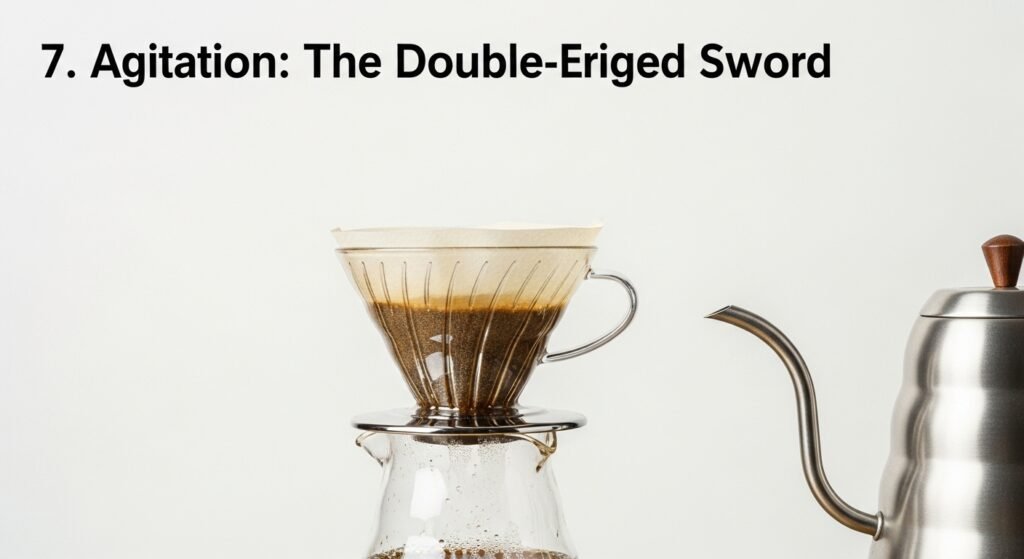
We often hear baristas talk about “stirring the bloom” or “swirling the dripper.” These are manual forms of agitation.
By stirring the grounds with a spoon or swirling the brewer, you are using centrifugal force to ensure every particle is saturated. This can increase extraction and sweetness, but it also increases the risk of clogging the filter.
The physics of a “swirl” helps move the grounds away from the walls of the filter and back into the center of the flow. This ensures that the water has to pass through the thickest part of the coffee bed, leading to a better Science of Coffee Body: What Creates That Syrupy Mouthfeel?.
8. Putting it Together: The Perfect Pour Protocol
If you want to apply these physics principles to your morning routine, follow this “High-Performance” workflow:
-
Low and Steady: Keep the spout of your kettle about 2 to 3 inches above the water surface. This provides enough agitation to stir the grounds but not enough to clog the filter.
-
The Concentric Circle: Start in the center and move outward in slow, steady circles. This ensures that the “fresh” water is always hitting new grounds.
-
The Pause: Use a “pulse pour” method. Instead of pouring all the water at once, pour in 50g increments. This keeps the water level low, reducing head pressure and giving you more control over the contact time.
-
The Final Swirl: Once you finish your last pour, give the dripper a gentle swirl. This levels the bed and ensures a clean, even draw down.
Summary: The Physics Checklist
| Factor | Effect on Brew | Why? |
| High Kettle Height | Increases Agitation | Water gains kinetic energy as it falls. |
| Fast Flow Rate | Lower Extraction | Higher head pressure moves water faster. |
| Gooseneck Spout | Laminar Flow | Straight, predictable stream for precision. |
| Plastic Dripper | Better Heat Retention | Plastic is a superior thermal insulator. |
| The Swirl | Even Extraction | Centrifugal force levels the coffee bed. |
Final Thoughts
Making a pour-over is a beautiful intersection of art and science. While we often focus on the flavor notes or the origin of the beans, it is the fundamental laws of physics that actually build the cup.
By understanding how kettle height, flow rate, and heat retention interact, you move from “following a recipe” to “controlling the variables.” You begin to understand why the coffee tastes the way it does, and more importantly, how to fix it when it goes wrong.
The next time you pick up your gooseneck kettle, don’t just think about the coffee. Think about the energy you are transferring into that dripper. Control the height, master the flow, and let gravity do the rest. Your palate will notice the difference that physics makes.
Happy (and precise) brewing!

Marcelo Clark combines professional industry experience with a passion for democratizing coffee knowledge. Specialist in extraction techniques and an advocate for single-origin beans, Marcelo uses this space to teach beginners how to appreciate the subtle notes of a well-crafted brew. His goal is to make learning about methods and origins simple, relevant, and inspiring for every reader’s daily routine.