
Imagine you are blindfolded and someone hands you three different liquids: a glass of water, a glass of whole milk, and a glass of maple syrup. Even without smelling or tasting them, you could identify them instantly just by how they move across your tongue. You are perceiving their body.
In coffee, “body” (or mouthfeel) is the tactile sensation of the liquid’s weight and texture. It is the difference between a coffee that feels like a delicate herbal tea and one that feels like a thick, velvety soup.
For many coffee lovers, body is the “soul” of the cup. It is the quality that makes a morning latte feel comforting and an espresso feel powerful. But body isn’t an accident. It is a complex result of cellular structures, roasting chemistry, and the physics of filtration.
In this guide, we are going to look under the microscopic lens to see exactly what gives coffee its weight, why some brewing methods produce “thin” coffee, and how you can manipulate your technique to achieve that elusive, syrupy mouthfeel.
1. The Three Pillars of Body: Lipids, Proteins, and Polysaccharides
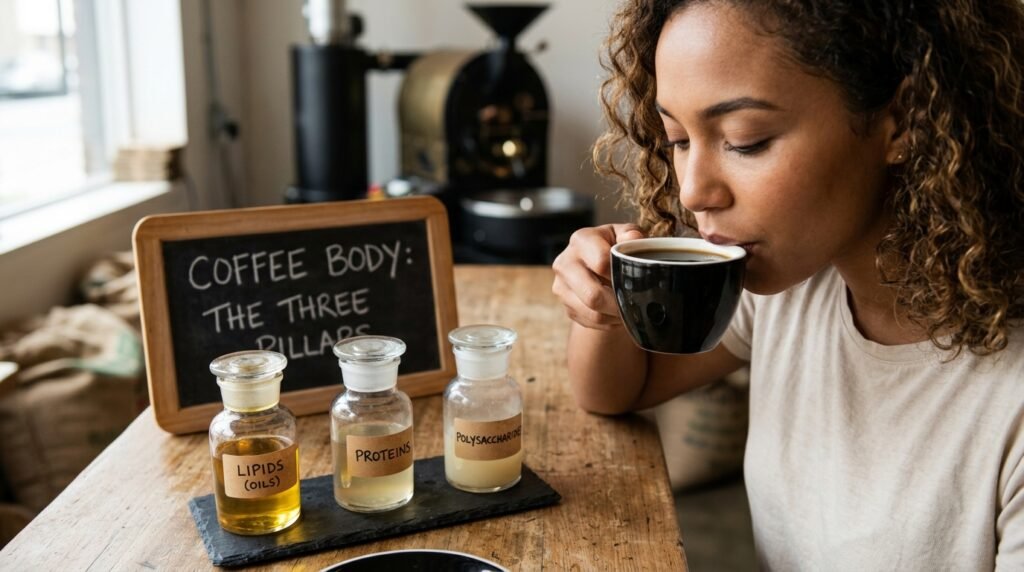
To understand body, we have to look at what is actually floating in your cup. Coffee isn’t just a solution; it is a suspension of microscopic particles. There are three main chemical groups responsible for the “heft” of your coffee:
-
Lipids (Oils): These are the fats found within the coffee bean. During roasting and brewing, these oils are released and emulsified into the water. They coat the tongue, creating a sensation of “creaminess” and “smoothness.”
-
Proteins: Coffee beans contain a significant amount of amino acids. While some are lost during roasting, many survive into the cup, contributing to the overall viscosity.
-
Polysaccharides (Sugars/Carbohydrates): These are complex sugar chains. They don’t necessarily make the coffee taste “sweet,” but they add “stickiness” and thickness to the liquid, much like how starch thickens a sauce.
When these three groups work together, they create a liquid that is physically “thicker” than water. This is a key reason why The Chemistry of Extraction: Balancing Acid, Sweet, and Bitter is so important; if you under-extract, you miss out on the heavier polysaccharides, leaving your coffee feeling “watery.”
2. The Role of the Filter: The Gatekeeper of Body
The single biggest factor in determining the body of your coffee isn’t the bean—it’s the filter.
If you use a paper filter (like in a V60 or Chemex), the paper acts as a microscopic wall. It is designed to trap two things: fines (tiny coffee dust) and oils. By removing the oils, the paper filter creates a “clean,” tea-like body. It allows the acidity to shine but reduces the weight.
If you use a metal filter (like in a French Press or espresso machine), the oils and fines pass directly into your cup. These particles stay in suspension, physically increasing the viscosity of the liquid. This is why How to Choose the Best Coffee for Each Brewing Method is a decision that starts with how you want the coffee to feel. If you want a heavy, syrupy cup, you must choose a method that doesn’t use a thick paper filter.
3. Terroir and Variety: The Genetics of Texture
While the filter is the “gatekeeper,” the “potential” for body starts at the farm. Not all coffee beans are created equal when it comes to lipids and sugars.
-
Robusta vs. Arabica: Robusta beans naturally have more body-building compounds (specifically more fibers and proteins) but fewer delicate oils. This is why Robusta is often used in espresso blends to provide a thick, stable “crema.”
-
Altitude: As we explored in our deep dive into High Altitude Coffee, trees grown in thin mountain air grow more slowly. This slow growth allows the bean to develop more complex sugar chains (polysaccharides) and higher density, which translates directly to a fuller body in the cup.
-
Processing: The “Natural” process (drying the bean inside the fruit) allows the bean to absorb more sugars and pectin from the cherry. This is why a Natural process coffee from Brazil or Ethiopia almost always has a “syrupy” or “jammy” mouthfeel compared to its “Washed” counterparts.
4. The Maillard Reaction: Roasting for Weight
Roasting is where the “body” is literally cooked into existence. One of the most important chemical reactions in roasting is the Maillard Reaction—the interaction between amino acids and reducing sugars that browns the bean.
During this phase, complex molecules called melanoidins are formed. Melanoidins are brown, high-molecular-weight polymers that are incredibly effective at increasing the viscosity of water.
A skilled roaster can “stretch” the Maillard phase to create more melanoidins, resulting in a coffee with more body. Generally speaking, medium and dark roasts have more “perceived” body because the roasting process has had more time to break down the bean’s structure and release the oils. However, if you roast too dark, you begin to burn away the very oils that create the “creamy” sensation, leading to a “thin” but bitter cup.
5. Pressure and Emulsification: The Espresso Secret
Why is espresso so much thicker than drip coffee? It’s not just the ratio of coffee to water; it’s the pressure.
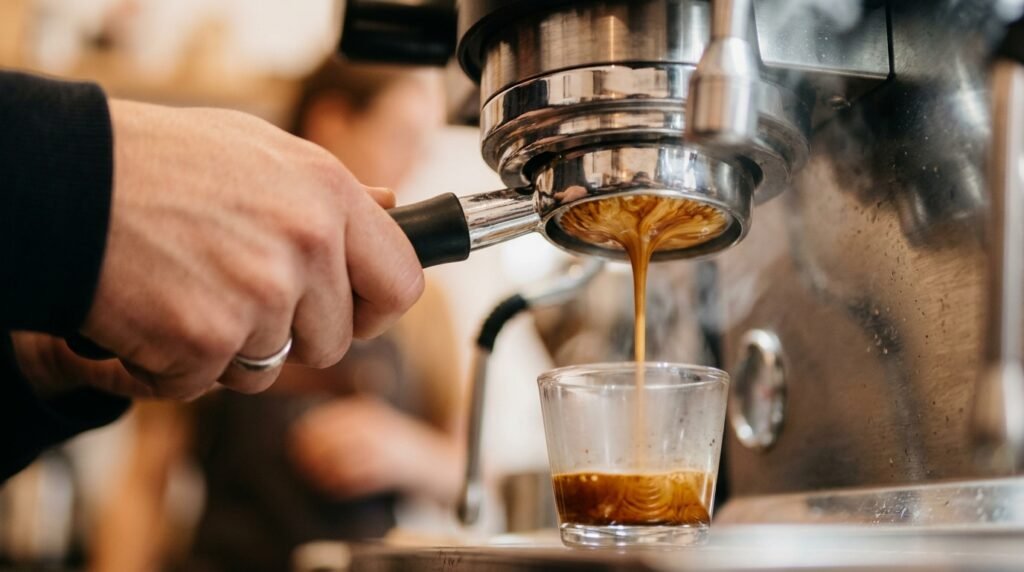
When you force 90°C water through a tightly packed “puck” of coffee at 9 bars of pressure, you are performing a feat of high-speed chemistry. The pressure forces the oils out of the coffee cells and “emulsifies” them. This means the oil and water, which usually don’t mix, are forced into a stable, creamy suspension.
This emulsion is what we call Crema. Crema is a foam made of CO2 bubbles trapped inside an oil-and-water film. It is the ultimate expression of coffee body. Without pressure, you can never achieve the syrupy, tongue-coating intensity of a true espresso shot.
[Image showing a macro view of the “tiger stripping” in espresso crema]
6. Training Your Palate: Describing Mouthfeel
If you want to move beyond just saying a coffee is “thick” or “thin,” you can use the professional sensory lexicon. When cuppers (professional tasters) talk about body, they use specific descriptors:
-
Silky/Velvety: A smooth, light coating that feels like luxury fabric.
-
Syrupy: Heavy, high-sugar sensation that lingers on the back of the tongue.
-
Tea-like: Very thin, clean, and refreshing, with almost no oil presence.
-
Creamy: High lipid content, often associated with dairy-like thickness.
-
Astringent: Not a body type, but a “feeling.” It’s that dry, puckering sensation (like over-steeped tea) that usually indicates over-extraction.
By paying attention to the texture of each sip, you can start to identify the processing methods and origins of your beans without even looking at the bag.
7. How to “Boost” Body in Your Home Brew
If your home coffee is feeling a bit “watery,” here are three ways to fix it:
-
Lower Your Ratio: If you usually use 60g of coffee per liter of water (a 1:16 ratio), try moving to 65g or 70g (a 1:14 ratio). More coffee means more dissolved solids, which means more body.
-
Increase Your Temperature: Hotter water is a more aggressive solvent. It is better at melting the lipids and breaking down the polysaccharides that create weight. Try bumping your kettle up by 2°C or 3°C.
-
Shorten Your Brew Time (with a finer grind): By grinding finer, you increase the surface area, allowing those heavy “body” compounds to extract more quickly. Just be careful not to go so fine that you create “channeling” or bitterness.

8. The Psychological Power of Body
There is a reason why “Full-Bodied” is such a popular marketing term. Psychologically, humans associate thickness and viscosity with nutrition and value. In our evolutionary history, a “thick” liquid was more likely to be calorie-dense and life-sustaining than a thin, watery one.
This is why we find a syrupy coffee so satisfying. It triggers a primitive “reward” signal in our brain that tells us we are consuming something substantial. When you combine this tactile satisfaction with the aromatic complexity of a great bean, you get a “complete” sensory experience that lingers long after the cup is empty.
Summary: Body at a Glance
| Factor | Effect on Body | Why? |
| Metal Filter | Increases | Allows oils and fines to pass through. |
| Paper Filter | Decreases | Traps oils and sediment for a “clean” cup. |
| Natural Process | Increases | Absorbs more sugars and pectin from the fruit. |
| Washed Process | Decreases | Removes mucilage for a more acidic, lighter profile. |
| Darker Roast | Increases | More melanoidins and surface oils are developed. |
| High Pressure | Increases | Emulsifies oils into a thick, creamy suspension. |
Final Thoughts
Coffee body is the “weight” that carries the flavor. Without it, even the most aromatic coffee can feel hollow and unsatisfying. It is the invisible architecture of the cup.
By understanding the science of lipids, proteins, and filtration, you can stop guessing and start engineering the exact texture you want. Whether you prefer the sparkling clarity of a paper-filtered pour-over or the heavy, syrupy hug of a French Press, the body is a variable you can control.
The next time you take a sip, don’t just ask “what do I taste?” Ask “how does this feel?” Pay attention to the way the liquid coats your tongue and how long that sensation lasts. You might find that the texture of your coffee is the very thing that keeps you coming back for “just one more cup.”
Happy brewing, and may your mouthfeel always be velvety!

Marcelo Clark combines professional industry experience with a passion for democratizing coffee knowledge. Specialist in extraction techniques and an advocate for single-origin beans, Marcelo uses this space to teach beginners how to appreciate the subtle notes of a well-crafted brew. His goal is to make learning about methods and origins simple, relevant, and inspiring for every reader’s daily routine.