
If South American coffee is the “comfort food” of the industry—full of chocolate, nuts, and caramel—then African coffee is the “haute cuisine.” It is daring, complex, and often tastes more like a fine tea or a basket of fresh berries than the traditional “coffee” flavor most people grew up with.
In the world of specialty coffee, the mention of Ethiopia or Kenya on a bag is enough to make a connoisseur’s heart beat faster. These two nations sit at the center of the East African coffee belt, yet they offer two distinct philosophies of flavor. Ethiopia gives us the “Heirloom” mystery and floral elegance, while Kenya provides a bold, phosphoric acidity and a “winey” intensity that is unrivaled globally.
Understanding these two profiles isn’t just about geography; it’s about understanding how history, soil chemistry, and unique processing methods create the most sought-after beans on the market. In this guide, we are going to travel from the high-altitude forests of Kaffa to the volcanic slopes of Mount Kenya to see why the “Rise of African Coffees” has changed the specialty world forever.
1. Ethiopia: The Genetic Motherland
We cannot talk about African coffee without starting at the beginning. As we have seen in our previous explorations, Ethiopia is the birthplace of Coffea arabica. But what makes Ethiopia so special in the modern market is its genetic diversity.
While most countries grow specific varieties like Bourbon or Caturra, Ethiopia is home to thousands of “Landrace” varieties that grow wild. When you drink Ethiopian coffee, you are often drinking a blend of these wild varieties, simply labeled as “Heirloom.”
This diversity is why The Science of Coffee Aromas: How Your Nose Determines Flavor is so vital for this origin. The sheer number of volatile aromatic compounds found in an Ethiopian Yirgacheffe or Sidamo is staggering. You don’t just “taste” this coffee; you experience a bouquet of jasmine, bergamot, and citrus that begins the moment the hot water hits the grounds.

2. Kenya: The Precision of the SL Varieties
If Ethiopia is about “wild mystery,” Kenya is about “scientific precision.” Coffee was introduced to Kenya much later than Ethiopia, and the industry was built with a focus on research and quality control.
In the 1930s, Scott Agricultural Laboratories (now known as SL) was commissioned to find the best varieties for the Kenyan climate. They developed SL28 and SL34—two varieties that have become the “Gold Standard” for Kenyan coffee. These varieties are famous for their deep root systems, which allow them to survive in dry conditions and pull complex minerals from the deep volcanic soil.
The result is a flavor profile that is “explosive.” Kenyan coffee is known for a bright, tomato-like or blackcurrant acidity that is incredibly clean. This clarity is a direct result of the “Kenyan Process,” a unique method of double-washing that we will explore later in this article.
3. The “Kenyan Process”: The Art of Double Washing
One of the reasons Kenyan coffee stands out in Calibrating Your Espresso: The Dialing-In Process is its extreme cleanliness. This comes from a processing method that is more labor-intensive than almost anywhere else in the world.
After the coffee cherries are depulped, they undergo a “dry” fermentation for up to 24 hours. They are then washed and fermented a second time in clean water for another 12 to 24 hours. Finally, they are soaked in “soak tanks” for an additional day.
This “Double Wash” removes every single trace of mucilage and “polishes” the bean. Scientifically, this process increases the amino acids and proteins within the bean, which contributes to that famous “savory-sweet” complexity. It is the antithesis of the “Natural Process” used in parts of Ethiopia, which focuses on fruit fermentation.
4. Terroir: Volcanic Soil and High Altitudes
Both Ethiopia and Kenya benefit from incredible geography, but their “Terroir” (the environment) offers different mineral gifts to the coffee tree.
-
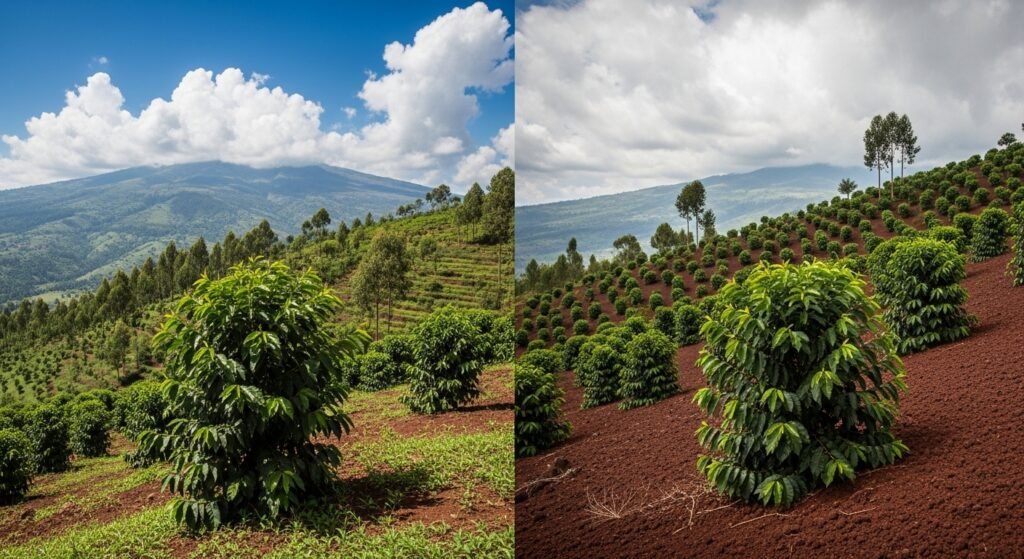
Ethiopia: Most coffee grows in “Forest” or “Semi-Forest” systems. The soil is rich in organic matter from thousands of years of leaf litter. This promotes the delicate, floral, and tea-like notes.
-
Kenya: The coffee grows on the slopes of Mount Kenya and the Aberdare Range in deep, red volcanic soil. This soil is packed with phosphoric acid.
Phosphoric acid is the same acid found in many sodas; it creates a “tingling” sensation on the tongue. This is why Kenyan coffee feels so “effervescent” and bright. It is a physical sensation that contributes to The Science of Coffee Body: What Creates That Syrupy Mouthfeel?, creating a “winey” body that is heavy yet clean.
5. The Grading System: AA, AB, and the “Peaberry”
Kenya is also unique for its strict grading system based on bean size. While size doesn’t always equal quality, in Kenya, it is a key part of the auction system.
-
AA: The largest beans. They are prized for their consistency in roasting.
-
AB: A mix of A and B sizes. Often the best value-for-money, as the flavor is nearly identical to AA.
-
PB (Peaberry): A natural mutation where only one seed grows inside the cherry instead of two. Many believe Peaberries are sweeter because the tree “concentrated” all its energy into a single bean.
In Ethiopia, the grading is more focused on the “Cup Quality” (Grade 1 through Grade 5) and whether the coffee was “Washed” or “Natural.” A Grade 1 Washed Yirgacheffe is widely considered one of the cleanest, most elegant beverages on the planet.
6. Brewing the African Giants: A Tale of Two Filters
Because African coffees are so acidic and aromatic, they require a specific approach to brewing. If you use a method that is too aggressive, you will lose the nuance.
For Ethiopia (The Delicate Approach):
Use a V60 or a Chemex with a thin paper filter. You want to highlight the “treble” notes of jasmine and lemon. If your water is too hot, you risk burning off the delicate oils. Aim for around 92 degrees Celsius.
For Kenya (The Bold Approach):
A V60 is still great, but many enthusiasts love a Kenyan coffee in an AeroPress or even a high-clarity espresso. The goal is to balance that “blackcurrant” acidity with enough sweetness. Because Kenyan beans are very dense, they can handle slightly higher temperatures (94–95 degrees Celsius) to ensure full extraction.
7. The Coffee Auction: A Model for Quality
Kenya’s “Nairobi Coffee Exchange” is one of the most transparent and quality-focused auction systems in the world. It encourages farmers to produce the best possible coffee because high scores lead to significantly higher prices.
Ethiopia recently modernized its system through the Ethiopia Commodity Exchange (ECX), which helped standardize quality but initially made it harder to trace coffee back to a single small farm. Today, new laws allow for more “direct trade,” meaning you can often find Ethiopian bags that name the specific washing station or even the farmer, such as those from the famous “Guji” or “Aricha” regions.
This traceability is essential for the “Humanized” coffee movement. When you know the name of the washing station, you are no longer just drinking a commodity; you are participating in the economy of a specific community.
8. Flavor Profiles: A Quick Reference
If you are standing in a coffee shop and can’t decide between the two, here is a “cheat sheet” for your palate:
| Feature | Ethiopia (Washed) | Kenya (Washed) |
| Primary Aroma | Jasmine, Honeysuckle, Earl Grey | Blackcurrant, Tomato, Blackberry |
| Acidity Type | Citric (Lemon/Lime) | Phosphoric (Sparkling/Winey) |
| Body | Light, Tea-like, Silk | Medium-Heavy, Syrupy |
| Flavor Notes | Bergamot, Peach, Apricot | Grapefruit, Spice, Dark Chocolate |
| Genetic Type | Heirloom (Wild) | SL28, SL34, Ruiru 11 |
9. The Natural Process: Ethiopia’s Funky Side
While we have focused on “Washed” coffees for their clarity, we cannot ignore the “Natural” process, especially in Ethiopia.
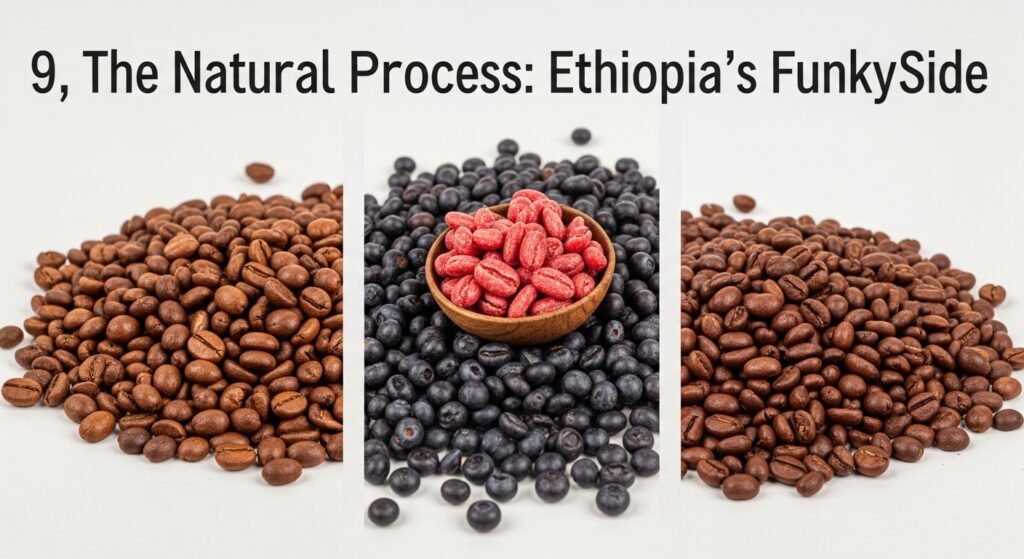
A natural-process Sidamo or Guji is a “fruit bomb.” Because the beans dry inside the fruit, they absorb the concentrated sugars. This leads to flavors that taste like dried strawberries, blueberries, or even tropical fruits like mango.
In Kenya, natural processing is rare but starting to emerge as farmers experiment with new ways to reach the specialty market. However, for most of the world, “Kenya” will always mean the pinnacle of the “Washed” profile.
10. The Challenges: Climate and Sustainability
Despite their fame, East African coffee farmers face massive challenges. Climate change is making rainfall patterns unpredictable, which is a disaster for countries that rely on specific seasons for flowering and drying.
Furthermore, as the younger generation in Ethiopia and Kenya moves toward cities, there is a “labor crisis” on the farms. This is why paying a “Specialty Premium” is so important. When you pay more for a bag of AA Kenya or Grade 1 Ethiopia, you are providing the financial incentive for the next generation to keep these ancient and scientific traditions alive.
Final Thoughts
The “Rise of African Coffees” is more than just a trend in Western cafes. It is the story of two nations that have taken their natural gifts—the highest altitudes, the richest soils, and the oldest trees—and turned them into a global standard for excellence.
Ethiopia gives us the soul of coffee—the floral, haunting, and mysterious notes that remind us of the plant’s wild origins. Kenya gives us the peak of coffee engineering—the bold, winey, and perfectly clean profiles that show us what happens when we pursue quality with absolute precision.
The next time you brew a cup from East Africa, take a moment to look at the color of the roast. It will likely be light, preserved to show you the work of the soil and the sun. Breathe in the aroma. Is it jasmine? Is it blackcurrant? Whatever you find, you are tasting the best of what the “Mother Continent” has to offer.
Happy brewing, and may your cup be as vibrant as the African highlands!

Marcelo Clark combines professional industry experience with a passion for democratizing coffee knowledge. Specialist in extraction techniques and an advocate for single-origin beans, Marcelo uses this space to teach beginners how to appreciate the subtle notes of a well-crafted brew. His goal is to make learning about methods and origins simple, relevant, and inspiring for every reader’s daily routine.