
There is a common misconception in the world of specialty coffee that “fresher is always better.” We’ve been conditioned to look for the “Roasted On” date and choose the bag that was filled yesterday. While it’s true that you don’t want old, stale coffee, there is a hidden danger in drinking coffee that is too fresh.
If you’ve ever brewed a cup of coffee that tasted metallic, overly acidic, or had a strange “fizzy” mouthfeel, you might have been drinking a bean that hadn’t finished its first major life stage: Degassing.
Coffee is a living chemical product. Even after the flame is turned off and the beans have cooled, a violent internal struggle is taking place inside the cellular structure of the bean. This struggle involves the release of gases that were trapped during the roasting process. Until these gases leave, the flavor of the coffee remains “locked” away.
In this guide, we are going to explore the chemistry of the “resting” period. We will look at why CO2 is both the protector and the enemy of flavor, how to identify “stale” vs. “fresh,” and why that little one-way valve on your coffee bag is a masterpiece of engineering.
1. The Birth of the Gas: What Happens Inside the Roaster?
To understand degassing, we first have to look at what happens during the roast. When green coffee is heated, several chemical reactions occur. The most important for our discussion is the Maillard Reaction and the caramelization of sugars.
As the bean’s internal temperature rises, the moisture (H2O) inside turns into steam. This creates immense pressure within the cellulose structure of the bean. At the same time, the complex carbohydrates are breaking down, a process that generates a massive amount of CO2 (Carbon Dioxide).
When the bean reaches “First Crack,” the cellular walls are literally popping open under the pressure of this gas. When the roast is finished, the bean is like a tiny, pressurized sponge, holding onto a significant volume of CO2. In fact, a freshly roasted bean can contain up to several liters of gas relative to its size.
This gas is vital because it acts as a shield, preventing oxygen from entering the bean and making it stale. However, as we will see, it also creates a barrier that prevents water from doing its job during brewing. This balance is a key part of The Chemistry of Extraction: Balancing Acid, Sweet, and Bitter.
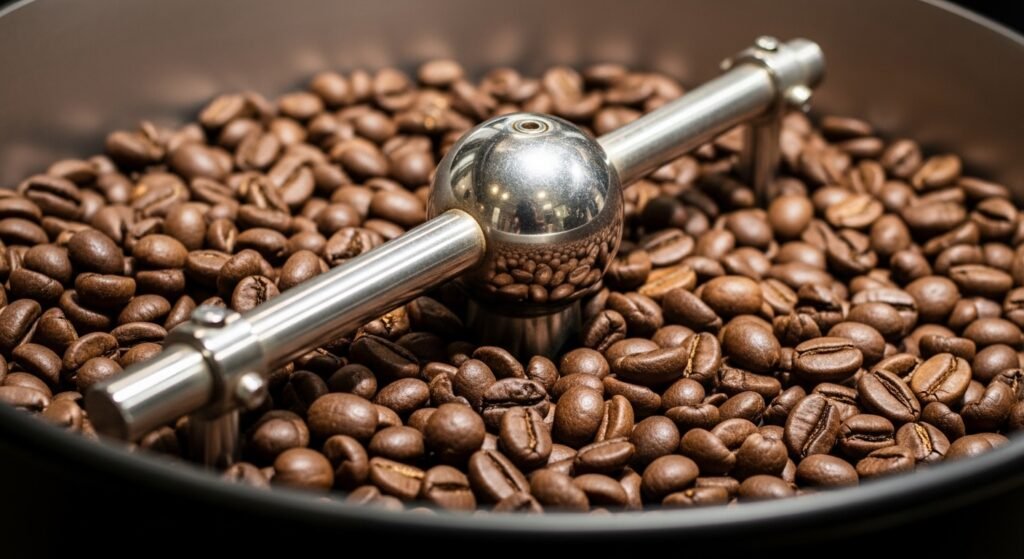
2. The “Fizzy” Problem: Why You Can’t Brew Day-One Coffee
If you try to brew a coffee that was roasted four hours ago, you are going to have a bad time.
When you add hot water to “ultra-fresh” grounds, the CO2 tries to escape all at once. This creates a violent “bloom” that is so aggressive it actually pushes the water away from the coffee particles.
Think of it like trying to walk through a doorway while a crowd of people is rushing out. You (the water) can’t get in because the gas is pushing out with too much force. The result is uneven extraction. You end up with “dry pockets” in your coffee bed, and the final cup tastes “under-developed,” sour, and surprisingly salty.
Furthermore, CO2 itself has a flavor. When dissolved in water, it forms carbonic acid. If your coffee hasn’t degassed, your cup will have a sharp, “sparkling” acidity that masks the delicate floral and fruity notes we worked so hard to find in The Rise of African Coffees: Ethiopia and Kenya Profiles.
3. The Degassing Timeline: The “Peak Flavor” Window
Every coffee bean has a “Peak Flavor” window—the period after roasting where the gas has left, but the aromatic oils haven’t yet begun to oxidize.
The speed of degassing depends on two things: the roast level and the bean density.
-
Dark Roasts: These beans have a more “broken” cellular structure. The gas escapes very quickly. A dark roast might be ready to drink in 2 to 3 days.
-
Light Roasts: These beans are denser and “tougher.” The CO2 is trapped deep in the fibers. A very light roast (like those used for pour-overs) often tastes better 7 to 14 days after the roast date.
This is why many specialty roasters won’t even put their coffee on the shelf until it has rested for at least a few days. They want you to experience the coffee at its peak, not during its “gassy” phase.
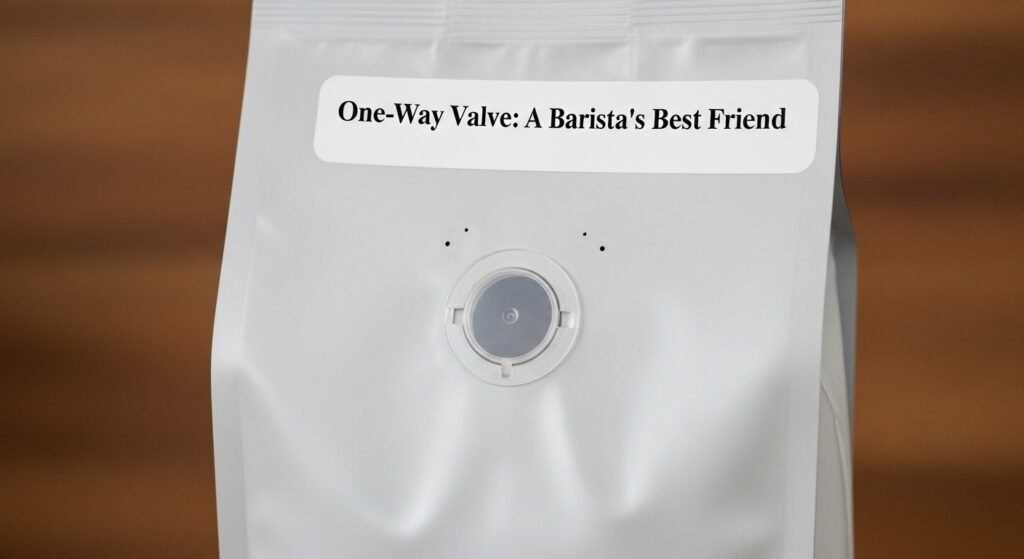
4. The One-Way Valve: A Barista’s Best Friend
Have you ever wondered about that little plastic circular valve on your coffee bag? Many people think it’s for smelling the coffee (the “squeeze and sniff” test), but that is actually a secondary effect.
That is a One-Way Degassing Valve. Because freshly roasted coffee releases so much CO2, if you sealed it in a completely airtight bag, the bag would eventually explode under the pressure. The valve allows the CO2 to escape the bag while preventing oxygen from entering.
Oxygen is the ultimate enemy of coffee freshness. Once oxygen enters the bean, it begins to oxidize the delicate lipids (oils). This is what creates that “stale” flavor that tastes like cardboard or old peanuts. The valve keeps the bag in a “CO2-rich” environment, which acts as a natural preservative, keeping the beans fresh for much longer.
5. Grinding and Surface Area: The Accelerator
The moment you grind your coffee, the degassing process accelerates by about 1,000%.
By breaking the bean into thousands of tiny pieces, you are exponentially increasing the surface area. The CO2 that was trapped deep inside is suddenly released all at once. This is why ground coffee goes stale so much faster than whole-bean coffee.
Within 15 to 30 minutes of being ground, a significant portion of the “aromatic headspace” (the smell) of the coffee is gone. This is why we always emphasize that The Science of the Burr: Why Blade Grinders are Killing Your Coffee is about more than just particle size—it’s about protecting the gas until the very second you are ready to brew.
[Image showing the surface area difference between a whole bean and ground coffee]
6. Storage Science: How to Stop the Clock
Since we know that heat, light, and oxygen are the enemies of freshness, how should you store your coffee once it has finished its initial degassing?
The Rules of Storage:
-
Airtight is Everything: Use a canister with a “plunger” or vacuum seal that pushes the air out.
-
Opaque, Not Clear: Light (UV rays) breaks down organic compounds. Never store your coffee in clear glass jars on the counter.
-
Cool and Dry: Avoid the “freezer myth.” While freezing can preserve coffee, the constant “thaw and refreeze” cycle creates condensation (H2O) inside the bag, which ruins the beans instantly. Keep your coffee in a cool, dark cupboard instead.
By following these rules, you can extend your “Peak Flavor” window from 2 weeks to nearly 6 weeks.
7. Identifying Stale Coffee: The “Bloom” Test
How can you tell if your coffee is past its prime? You don’t need a lab; you just need your eyes.
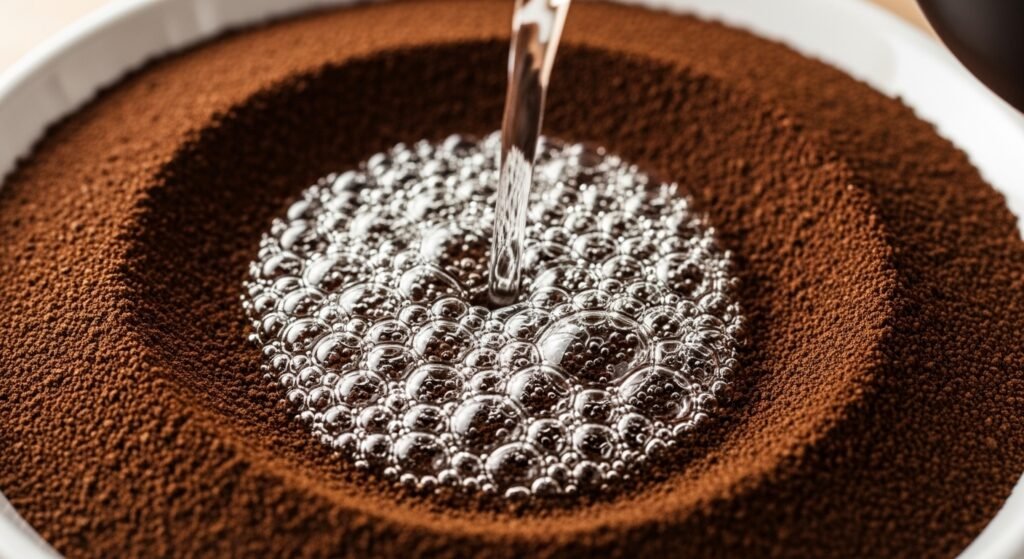
When you perform your “bloom” (the initial pour of water), watch the grounds.
-
Fresh Coffee: Will bubble, swell, and look “active.” This is the remaining CO2 escaping.
-
Stale Coffee: Will stay flat. It will look like wet sand.
If there is no bloom, there is no gas. If there is no gas, the oxygen has already done its damage. The coffee will likely taste flat, woody, and lack any of the vibrant “top notes” of the origin. It won’t have the syrupy mouthfeel we love in The Science of Coffee Body: What Creates That Syrupy Mouthfeel? because the oils have already begun to break down.
8. The Roaster’s Secret: Why They “Rest” Their Competition Coffee
In professional barista competitions, competitors almost never use coffee that was roasted the day before. They often use coffee that is exactly 12 to 21 days old.
Why? Because at that age, the CO2 is almost entirely gone, but the aromatic oils are at their absolute peak of stability. This allows the barista to be incredibly precise with their extraction. They don’t have to fight against gas bubbles, and they can use a finer grind to get more sweetness without the “fizzy” interference of carbonic acid.
Summary: The Freshness Timeline
| Days Since Roast | Status | Flavor Profile |
| Day 1 – 3 | Ultra-Fresh | High CO2, “Fizzy” acidity, unstable extraction. |
| Day 4 – 7 | Settling | Good for Dark/Medium roasts. Aromas starting to clarify. |
| Day 8 – 14 | Peak Flavor | Perfect balance for Light roasts. Vibrant and clear. |
| Day 15 – 30 | Stable | Great flavor, but beginning to lose delicate aromatics. |
| Day 30+ | Fading | Increasing “woody” notes. Oils starting to oxidize. |
Final Thoughts
The next time you buy a bag of specialty coffee, don’t be in a rush to open it the second you get home. Check the roast date. If it was roasted yesterday, give it a few days to “breathe.”
Understanding the science of degassing turns you from a passive consumer into an active participant in the coffee’s life cycle. You are learning to wait for the chemistry to settle, for the gas to leave, and for the true flavor of the bean to reveal itself.
Coffee freshness isn’t a race to the earliest possible date; it’s a journey to the “Sweet Spot.” Control your storage, respect the rest period, and always grind fresh. Your palate will reward you with a cup that is balanced, clear, and perfectly developed.
Happy (and patient) brewing!

Marcelo Clark combines professional industry experience with a passion for democratizing coffee knowledge. Specialist in extraction techniques and an advocate for single-origin beans, Marcelo uses this space to teach beginners how to appreciate the subtle notes of a well-crafted brew. His goal is to make learning about methods and origins simple, relevant, and inspiring for every reader’s daily routine.