
If you walk into a cafe during the height of summer, you’ll likely see a glass tower or a large stainless steel vat dripping slowly in the corner. This is the birthplace of Cold Brew. Unlike traditional iced coffee—which is just hot coffee poured over ice—Cold Brew is an entirely different beast.
It is a beverage born from patience. While a standard espresso takes 30 seconds and a pour-over takes 3 minutes, a proper Cold Brew takes anywhere from 12 to 24 hours.
But why do we do it? Is it just a trend, or is there a genuine chemical reason to wait an entire day for a cup of coffee?
The answer lies in the molecular behavior of the coffee bean. By removing heat from the equation, we change which compounds are extracted and which are left behind. The result is a drink that is famously smooth, naturally sweet, and incredibly low in acidity. In this guide, we are going to explore the physics of cold extraction, the role of oxidation, and why your choice of beans matters more here than in almost any other method.
1. The Solvent Debate: Heat vs. Time
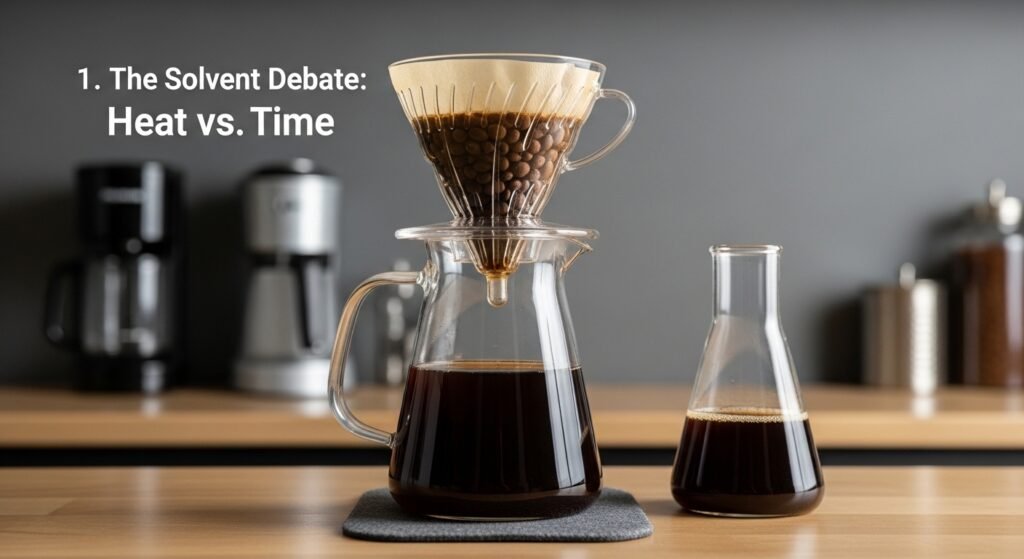
In the world of chemistry, water is known as the “universal solvent.” Its job is to dissolve the soluble solids inside the coffee grounds.
When we use hot water (around 92 to 96 degrees Celsius), we are using thermal energy to speed up this process. Heat acts like a catalyst, vibrating the molecules and forcing them to release their flavors quickly. However, heat is “aggressive.” It extracts everything—the good, the bad, and the bitter.
When we use cold water, we lose that thermal energy. To compensate, we have to increase the contact time. In the absence of heat, the water slowly “leaches” the flavors out of the beans.
Because cold water is less efficient at dissolving certain oils and acids, the resulting chemical profile is significantly different. This is why The Chemistry of Extraction: Balancing Acid, Sweet, and Bitter feels so different in a cold brew; the “Acid” part of the triangle is almost entirely removed from the start.
2. The Acidity Factor: Why It’s Gentler on the Stomach
The most famous characteristic of Cold Brew is its low acidity. Science shows that Cold Brew is roughly 60% to 70% less acidic than hot-brewed coffee.
This happens because many of the acidic compounds in coffee (like chlorogenic acids) only become soluble at high temperatures. When you brew with cold water, these acids stay trapped inside the coffee grounds and are eventually thrown away with the trash.
For people with sensitive stomachs or acid reflux, Cold Brew is a revelation. It provides the caffeine and the flavor without the “bite” that often causes discomfort. It also changes how we perceive The Science of Aftertaste: Why Great Coffee Lingers; instead of a sharp, acidic finish, Cold Brew leaves a coating of chocolatey sweetness that can last for minutes.
3. Oxidation and Degradation: The “Freshness” Paradox
Have you ever noticed that hot coffee tastes terrible once it goes cold? That “stale” flavor is caused by oxidation. When coffee is heated, the oils (lipids) in the bean begin to oxidize rapidly. When that hot coffee cools down, those oxidized oils turn sour and metallic.
Cold Brew avoids this because it never hits those high temperatures. Because the extraction happens at or below room temperature, the rate of oxidation is incredibly slow. This is the “superpower” of Cold Brew: it stays fresh for much longer. While a hot coffee is “dead” after 30 minutes, a bottle of Cold Brew concentrate can stay delicious in your refrigerator for up to two weeks.
4. Solubility and the “Sweetness” Illusion
You might have heard people say that Cold Brew is “naturally sweeter.” Scientifically, this is a bit of a trick.
Cold water doesn’t necessarily extract more sugar than hot water. In fact, heat is better at dissolving sugars. However, because Cold Brew doesn’t extract the bitter tannins and sharp acids that usually “mask” the sweetness, our palates perceive the drink as much sweeter.
It’s like listening to a song where the loud, distorted guitar (the acid) has been turned down, allowing you to finally hear the subtle melody of the piano (the sugars). This clarity is why Cold Brew is the perfect candidate for those focusing on The Science of Coffee Body: What Creates That Syrupy Mouthfeel?. The heavy, chocolatey texture isn’t being cut through by acidity, making the drink feel much more “syrupy” on the tongue.
5. The CO2 Barrier in Cold Water
In our guides on pour-overs, we talk about the “bloom”—the release of CO2 gas when hot water hits fresh grounds.
In Cold Brew, the bloom is much less dramatic because cold water doesn’t force the gas out as quickly. This creates a challenge: if the CO2 stays inside the grounds, it can act as a shield, preventing the water from getting in to extract flavor.
This is why immersion (soaking the grounds completely) is the most popular way to make Cold Brew at home. By letting the grounds sit submerged for 18 hours, you give the water enough time to eventually penetrate that CO2 barrier and reach the heart of the bean.
6. The Grind: Why “Coarse” is King
If you use a fine espresso grind for Cold Brew, you will end up with a muddy, over-extracted mess.
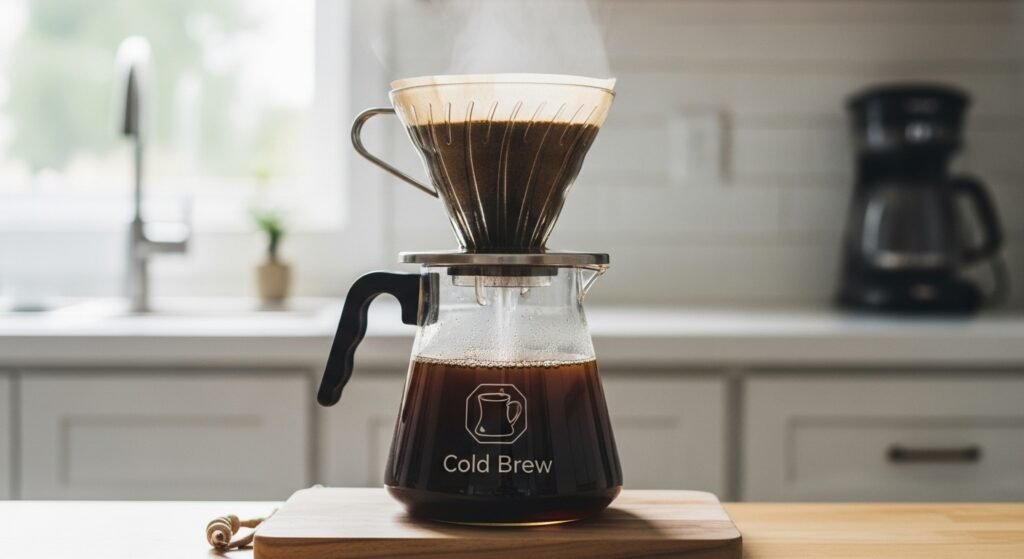
Because the coffee and water are going to be in contact for a very long time, you need to reduce the surface area. A very coarse grind (like sea salt) ensures that the water moves slowly into the particles.
Using a coarse grind also makes filtration much easier. Cold Brew is notorious for “clogging” filters because of the long steeping time. A coarse grind, achieved by a high-quality burr grinder as discussed in The Science of the Burr: Why Blade Grinders are Killing Your Coffee, ensures that your final product is clean and sediment-free.
7. Immersion vs. Slow Drip: Two Paths to the Cold Cup
There are two primary ways to achieve cold extraction:
The Immersion Method (The “Toddy” Style):
This is the most common home method. You mix coffee and water in a jar, let it sit for 12–24 hours, and then filter it.
-
The Result: A very heavy-bodied, chocolatey, and “punchy” concentrate. It is perfect for mixing with milk or water.
The Slow Drip Method (The “Kyoto” Style):
This uses a glass tower where water drips onto a bed of coffee one drop at a time (usually one drop every 1 to 2 seconds). The water passes through the coffee and into a carafe below.
-
The Result: A much more “bright” and “floral” Cold Brew. Because fresh water is constantly being introduced to the coffee, it captures more of the delicate aromatics that are usually lost in the “stagnant” water of an immersion brew.
8. Sourcing: Which Beans Shine in the Cold?
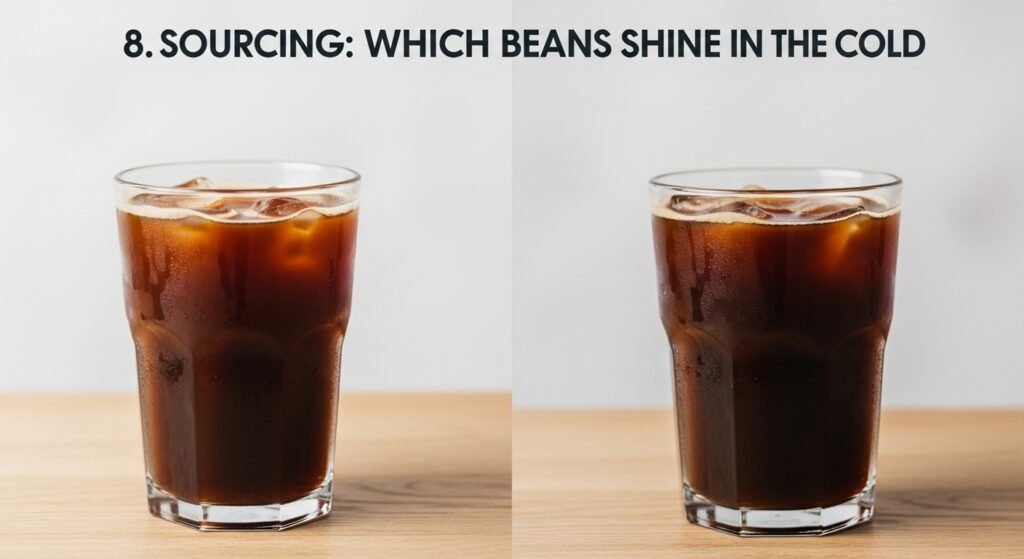
Because Cold Brew highlights “bass notes” (chocolate, nuts, earth) and mutes “treble notes” (citrus, floral), your choice of bean will drastically change the outcome.
-
Central/South American Beans: (Brazil, Colombia, Guatemala). These are the “classic” Cold Brew beans. They are naturally high in chocolate and nut profiles, which cold extraction amplifies into a dessert-like drink.
-
African Beans: (Ethiopia, Kenya). These are the “experimental” choice. While much of the floral aroma is lost, a Cold Brew made with Ethiopian beans can taste like incredible blueberry juice or dried fruit.
Regardless of the origin, you should look for “Freshly Roasted” beans. Even though Cold Brew is forgiving, stale beans will still produce a “papery” or “cardboard” flavor that even 24 hours of steeping can’t fix.
9. The Caffeine Mystery: Is Cold Brew “Stronger”?
There is a common myth that Cold Brew has way more caffeine than hot coffee. The truth is a bit more nuanced.
Caffeine is more soluble in hot water. Gram for gram, hot brewing extracts caffeine more efficiently. However, Cold Brew is almost always made with a much higher coffee-to-water ratio. While a standard hot coffee uses a 1:16 ratio, Cold Brew often uses a 1:4 or 1:8 ratio to create a concentrate.
Because you are using so much more “raw material” (coffee beans), the final liquid contains a higher concentration of caffeine. If you drink a full glass of Cold Brew concentrate without diluting it, you are consuming a massive amount of caffeine. Always remember: the “strength” of Cold Brew comes from the recipe, not the temperature.
Summary: Cold Brew vs. Hot Brew Comparison
| Feature | Cold Brew | Hot Brew |
| Extraction Time | 12 – 24 Hours | 30 Seconds – 5 Minutes |
| Water Temp | 5°C – 20°C | 90°C – 96°C |
| Acidity | Very Low | Moderate to High |
| Body | Heavy / Syrupy | Varies by Method |
| Shelf Life | Up to 2 Weeks (Fridge) | ~30 Minutes |
| Flavor Focus | Chocolate, Cocoa, Spice | Floral, Citrus, Brightness |
Final Thoughts
Cold Brew is the ultimate expression of “Slow Coffee.” It is a method that asks us to step away from the instant gratification of the modern world and wait for the chemistry to happen at its own pace.
By replacing heat with time, we unlock a version of the coffee bean that is kinder to our bodies and smoother on our palates. It is a drink that celebrates the heavy, sweet, and comforting side of coffee.
Whether you are brewing a large batch in a jar in your fridge or watching the hypnotic drip of a Kyoto tower, remember that you are performing a delicate act of molecular extraction. You are letting the water slowly, gently, coax the soul out of the bean.
The next time you enjoy a glass of Cold Brew on a hot afternoon, take a moment to appreciate the 18 hours of “quiet science” that went into that glass. It was worth the wait.
Happy (patient) brewing!

Marcelo Clark combines professional industry experience with a passion for democratizing coffee knowledge. Specialist in extraction techniques and an advocate for single-origin beans, Marcelo uses this space to teach beginners how to appreciate the subtle notes of a well-crafted brew. His goal is to make learning about methods and origins simple, relevant, and inspiring for every reader’s daily routine.