
If you walk into a high-end coffee bar and see a barista standing over two glass globes connected by a tube, with a bright orange beam of light or a gas flame underneath, you aren’t witnessing an alchemist trying to turn lead into gold. You are watching a Siphon brew.
Also known as a vacuum pot, the Siphon is often regarded as the “Final Boss” of coffee brewing. It is intimidating, fragile, and requires a level of attention to detail that few other methods demand. But for those who have tasted a perfectly executed Siphon brew, there is no going back.
It produces a cup of coffee that is remarkably clean—devoid of sediment, heavy in aroma, and possessing a clarity of flavor that makes a standard pour-over feel muddy by comparison.
But why does this strange-looking device produce such superior results? The answer isn’t magic; it is a beautiful demonstration of the relationship between vapor pressure, gravity, and filtration. In this guide, we are going to dive into the 19th-century history of the Siphon, the physics of the “vacuum,” and the step-by-step science of how to use one without breaking the glass (or your heart).
1. The Victorian Invention: A Brief History
The Siphon wasn’t invented by a modern barista. It was a product of the mid-1830s, a time when Europe was obsessed with the power of steam and the wonders of industrial engineering. While several inventors claimed the design, the most famous version was patented by a French woman, Marie Fanny Amelne Massot (better known as Mme. Vassieux), in 1841.
The goal was simple: coffee lovers of the time were tired of the “boiled” coffee that was common in the 19th century. Boiling coffee destroys the delicate volatile aromatics and creates a bitter, scorched taste. The Siphon offered a way to brew at a consistent, slightly-below-boiling temperature, keeping the flavors intact.
Today, the Siphon has been perfected by Japanese companies like Hario and Yama, turning a Victorian curiosity into a staple of the specialty coffee movement. This long-standing tradition of respecting the bean’s aromatic profile is why The Science of Coffee Aromas: How Your Nose Determines Flavor is so relevant to the Siphon; the entire device is essentially a machine built to protect your sense of smell.
2. The Physics of the Rise: Vapor Pressure
A Siphon consists of two chambers: the bottom globe (the “bulb”) and the top chamber (the “hopper”), connected by a glass siphon tube and a filter.
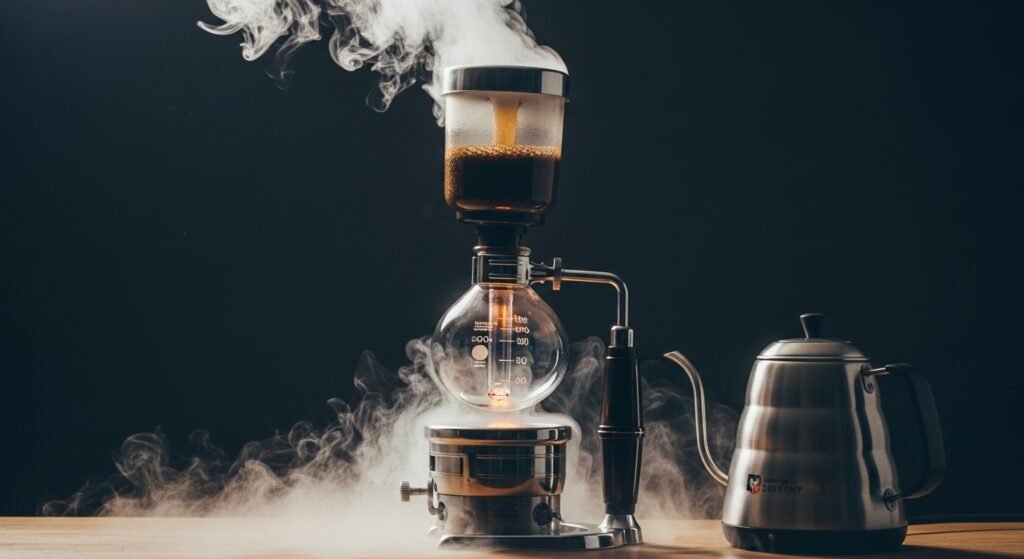
The process starts by heating water in the bottom bulb. As the water temperature rises, it begins to turn into water vapor (steam). Because the top chamber is sealed tightly into the bottom one with a rubber gasket, the steam has nowhere to go.
As more steam is produced, the vapor pressure inside the bottom bulb increases. Eventually, this pressure becomes so strong that it pushes the hot water up the siphon tube and into the top chamber.
The Science of “Soft” Boiling:
Notice that the water isn’t boiling when it hits the coffee. The pressure pushes the water up before it reaches a rolling boil, usually around 90 to 94 degrees Celsius. This is the “Goldilocks” zone for extraction, where you get all the sweetness and none of the burnt bitterness. This stability is key for The Chemistry of Extraction: Balancing Acid, Sweet, and Bitter.
3. The “Vacuum” Effect: The Descent
Once the water is in the top chamber, you add your coffee grounds and stir. The heat source underneath the bottom bulb continues to produce just enough steam to keep the water held up in the top chamber. This is called immersion brewing. But the real “magic” happens when you remove the heat source.
As the bottom bulb cools down, the steam inside it begins to condense back into liquid water. This creates a partial vacuum. Because nature abhors a vacuum, the atmospheric pressure outside the machine pushes down on the coffee in the top chamber, forcing it through the filter and back down into the bottom bulb.
This “suction” is much more powerful than the simple force of gravity used in a V60 or Chemex. The vacuum pulls the liquid through the filter with force, extracting every last drop of flavor while leaving the grounds behind in a perfectly dry “dome.”
4. The Role of the Cloth Filter: Clarity and Silk
Most Siphons use a cloth filter, though paper and metal versions exist. The cloth filter is the secret to the Siphon’s unique “mouthfeel.”
A paper filter (like in a Chemex) is very dense and removes almost all the coffee oils. A metal filter (like in a French Press) allows all the oils and a lot of fine sediment to pass through.
A cloth filter is the middle ground. It is porous enough to let the aromatic oils through, giving the coffee a silky, luxurious body, but fine enough to stop all sediment. This creates a cup that has the “syrupy” weight we discuss in The Science of Coffee Body: What Creates That Syrupy Mouthfeel?, but with the crystalline clarity of a pour-over.
5. Thermal Stability: The Siphon’s Hidden Advantage
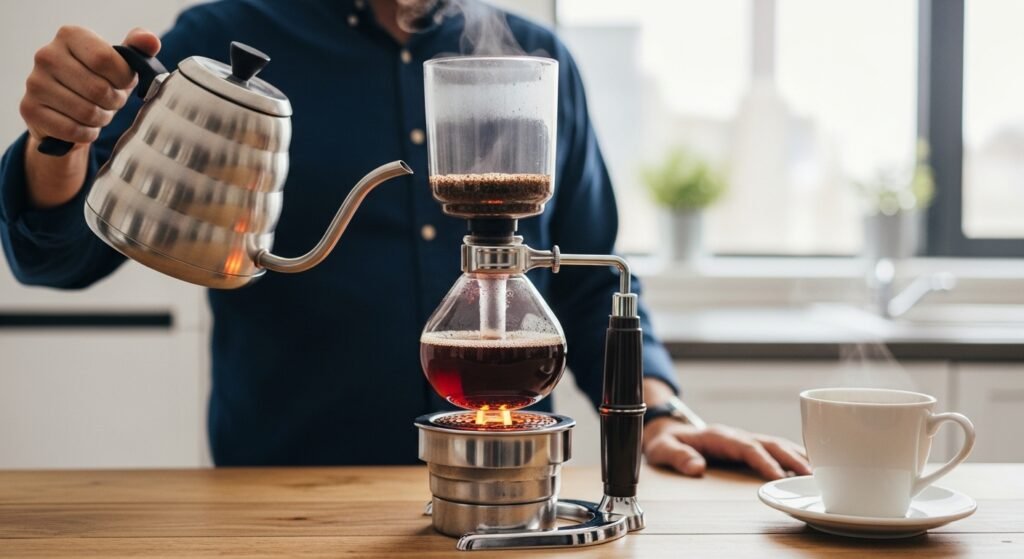
One of the biggest enemies of great coffee is temperature fluctuation. In a pour-over, the water is constantly cooling down as it sits in the kettle and travels through the air.
In a Siphon, the heat source is active throughout the entire immersion phase. This means the coffee is brewed at a perfectly stable temperature from the first second to the last. This consistency leads to a very “even” extraction. In a Siphon, you don’t get the “sour start” or “bitter finish” that can happen with poor pouring technique; you get a unified, balanced flavor profile.
6. The “Breathing Room” of the Grind
Because the Siphon uses a vacuum to pull water through the coffee, you have to be careful with your grind size.
If your grind is too fine (like espresso), the vacuum won’t be strong enough to pull the water through the dense “mud” of coffee. The brew will get “stuck,” and the coffee will over-extract while you wait.
If the grind is too coarse, the water will fly through too fast, and you’ll miss out on the complexity. You should aim for a “medium” grind, similar to what you would use for a V60. Since the Siphon is so sensitive to particle size, this is another reason why The Science of the Burr: Why Blade Grinders are Killing Your Coffee is non-negotiable for this method.
7. The Ritual: A Step-by-Step Guide
If you are ready to play scientist, here is the basic workflow:
-
Prep the Filter: If using cloth, make sure it is clean and damp. Secure it to the bottom of the top chamber.
-
Add Water: Fill the bottom bulb with hot water (this speeds up the process and prevents the glass from being stressed by long heating).
-
The Rise: Place the bulb over the heat source (butane burner or halogen lamp). Once the water starts to boil, insert the top chamber.
-
The Immersion: Once the water has moved to the top, lower the heat slightly. Add your coffee and give it a gentle “north-south-east-west” stir.
-
The Steep: Let it brew for about 45 to 60 seconds.
-
The Drawdown: Turn off the heat. Watch as the coffee is pulled back down into the bulb. If you see a “dome” of grounds at the top, you did it perfectly.
8. Maintenance: The Fragile Reality
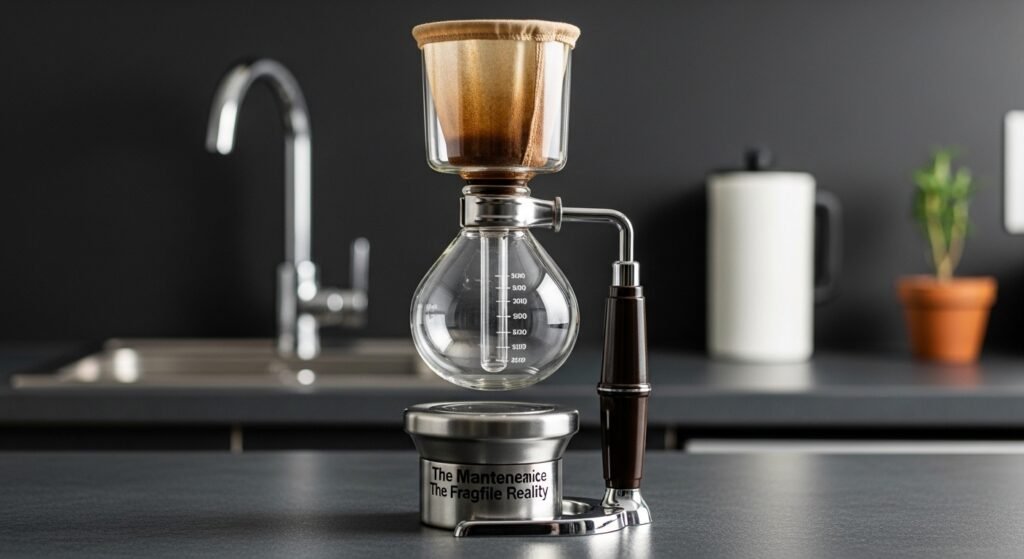
The Siphon is made of borosilicate glass, which is resistant to heat but not to gravity. The most common way Siphons “die” is through thermal shock or accidental bumps against the sink.
-
Cleaning: Never use abrasive sponges on the glass. Use a soft brush and warm, soapy water.
-
The Filter: Cloth filters are high-maintenance. They must be kept in a jar of water in the fridge between uses. If they dry out, the oils trapped in the fibers will go rancid and ruin your next cup.
-
The Gasket: Check the rubber seal regularly. If it cracks, you will lose the “vacuum” and your coffee won’t draw down.
Summary: The Siphon at a Glance
| Feature | Siphon (Vacuum Pot) |
| Brew Type | Full Immersion + Vacuum Filtration |
| Body | Silky and Medium-Heavy |
| Clarity | Very High (Sediment-free) |
| Best Filter | Cloth (Traditional) |
| Flavor Profile | Floral, Tea-like, and Highly Aromatic |
| Difficulty | High (Requires precision and care) |
Final Thoughts
The Siphon is the ultimate expression of coffee as a craft. It requires you to understand the physics of the environment, the chemistry of the water, and the biology of the bean.
It is not a “convenient” way to make coffee. It is a slow, methodical, and beautiful ritual. But the reward—a cup of coffee that tastes “high definition,” where every floral and fruity note is perfectly preserved—is unmatched by any other method.
If you are a home barista looking to push your skills to the limit, the Siphon is your next frontier. It forces you to slow down, to watch the bubbles, and to appreciate the invisible forces of nature that turn simple water and beans into a masterpiece.
Happy brewing, and may your glass always stay intact!

Marcelo Clark combines professional industry experience with a passion for democratizing coffee knowledge. Specialist in extraction techniques and an advocate for single-origin beans, Marcelo uses this space to teach beginners how to appreciate the subtle notes of a well-crafted brew. His goal is to make learning about methods and origins simple, relevant, and inspiring for every reader’s daily routine.