
Imagine standing in a bustling Italian train station in the late 1800s. You want a coffee, but the traditional brewing methods take too long. You have a train to catch. This was the problem that birthed “espresso”—a word that literally means “expressed” or “made on the spur of the moment.”
The espresso machine is perhaps the most complex tool in the culinary world. It is a machine that must simultaneously manage extreme heat, intense pressure, and delicate chemistry. Over the last 140 years, it has evolved from a massive steam-belching monster that produced bitter, burnt coffee into a digital masterpiece that can be controlled to the millisecond via a smartphone.
In this guide, we are going to walk through the four great “Ages” of the espresso machine. We will explore the inventors who risked their lives with high-pressure steam, the lever revolution that gave us “crema,” and the modern digital era that allows us to play with the very laws of physics to get the perfect shot.
1. The Steam Age: Angelo Moriondo and the Giant Boilers
The first espresso machines didn’t look like machines at all; they looked like industrial locomotives. In 1884, Angelo Moriondo of Turin patented the first machine that used steam and water to brew coffee rapidly.
However, there was a catch. These early machines used steam pressure to push water through a large bed of coffee. Because the water was pushed by steam, it was boiling—or hotter. As we know from The Chemistry of Extraction: Balancing Acid, Sweet, and Bitter, boiling water is the enemy of flavor.
The coffee produced by these machines was often scorched, watery, and lacked the “crema” we love today. It was fast, but it wasn’t necessarily good. These machines paved the way, but they lacked the one thing that defines modern espresso: Pressure independent of temperature.
2. The Piston Revolution: Gaggia and the Birth of Crema
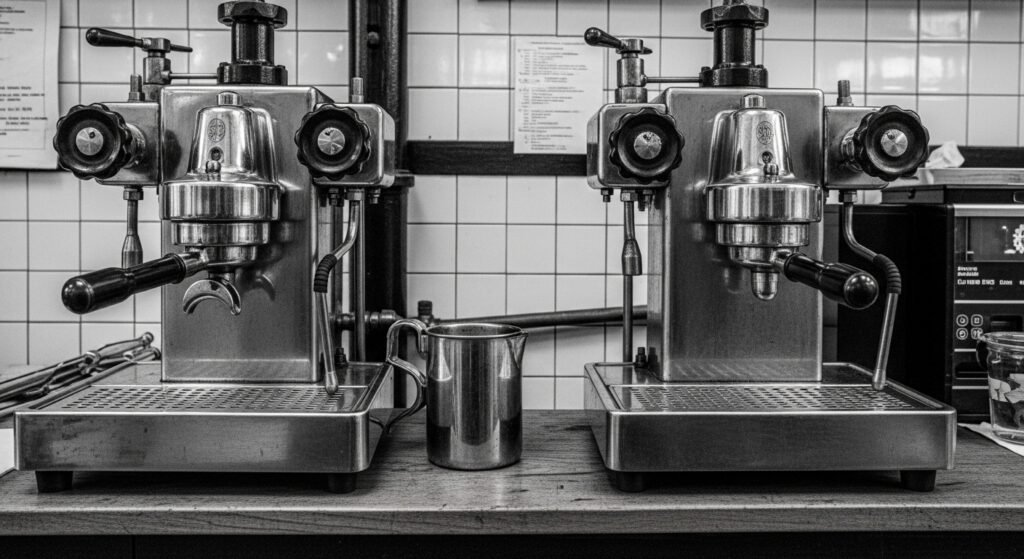
The biggest leap in coffee history happened in 1947, thanks to a Milanese cafe owner named Achille Gaggia.
Gaggia realized that to get the best flavor, he needed to separate the “heating” of the water from the “pushing” of the water. He developed a lever-operated piston system. When the barista pulled the lever, it compressed a powerful spring. When the lever was released, the spring pushed a piston that forced water through the coffee at a staggering 9 bars of pressure.
This was the birth of the “Crema Naturale.” Because the pressure was so high, it forced the CO2 and oils out of the coffee, creating a thick, golden foam on top. In fact, customers were initially suspicious of the foam, thinking it was soap! Gaggia had to market it as “caffe crema” to convince them it was a sign of quality. This heavy, oily texture is what we now study as The Science of Coffee Body: What Creates That Syrupy Mouthfeel?.
3. The Pump Era: Faema and the E61 Legend
While Gaggia’s lever machines were a massive improvement, they were inconsistent. A shot’s quality depended entirely on the strength and timing of the barista’s arm.
In 1961, Faema released the E61. This machine changed everything. Instead of a manual lever, it used an electric pump to provide a constant, steady 9 bars of pressure.
The E61 also introduced the “Heat Exchanger” system and the famous E61 Group Head, which circulated hot water through the metal to keep it at a perfectly stable temperature. This level of thermal stability is what allows baristas to avoid the bitter “hot spots” that ruin a shot.
Even today, 60 years later, many high-end home and commercial machines still use the E61 group head design. It is the “classic engine” of the coffee world. This era was the first time baristas could really begin Calibrating Your Espresso: The Dialing-In Process with scientific accuracy.
4. The Age of Precision: Dual Boilers and PIDs
As the specialty coffee movement grew in the 1990s and 2000s, baristas realized that “92 degrees” wasn’t always the best temperature. Different beans—like the floral Ethiopians we explored in The Rise of African Coffees: Ethiopia and Kenya Profiles—require different temperatures to shine.
This led to the “Dual Boiler” revolution. By having one boiler for steaming milk and a separate, smaller boiler for brewing coffee, machines could be much more precise.
Engineers then added PID Controllers. A PID is a small computer that monitors the water temperature hundreds of times per second, adjusting the heating element to ensure the temperature never fluctuates by more than 0.1 degree. This eliminated “temperature surfing” and turned the espresso machine into a true laboratory instrument.
5. The Digital Frontier: Pressure Profiling and Flow Control
We are currently living in the most exciting era of espresso history: the era of Pressure Profiling.
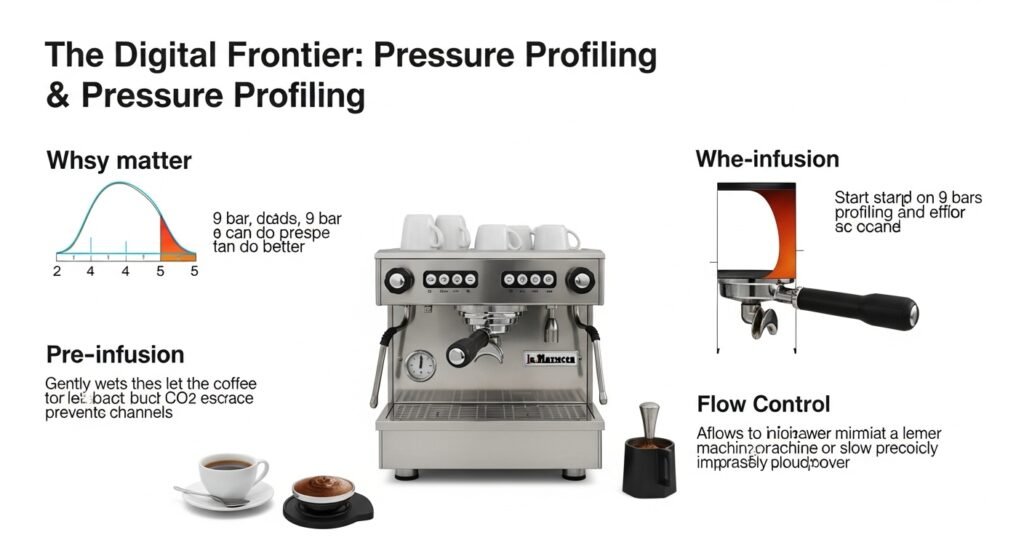
For decades, the “9 bar” rule was law. But modern machines, like those from Slayer, La Marzocco, and Decent Espresso, have proven that we can do better. We can now start a shot at 3 bars of pressure (Pre-infusion), ramp up to 9 bars, and then slowly drop back down to 5 bars as the puck of coffee degrades.
Why does this matter?
-
Pre-infusion: Gently wets the coffee to let the CO2 escape, preventing channeling.
-
Flow Control: Allows the barista to mimic a lever machine or a slow pour-over, unlocking flavors that were previously impossible to reach in espresso.
This is the ultimate expression of control. We are no longer just “making coffee”; we are sculpting the extraction in real-time.
6. Saturated Group Heads: The Quest for Thermal Perfection
In a standard machine, the “Group Head” (where you lock the portafilter) is separate from the boiler. Even with an E61 system, there is some heat loss.
Modern high-end machines use Saturated Group Heads. In this design, the group head is literally part of the boiler. It is filled with the same hot water, meaning the temperature at the screen is exactly the same as the temperature in the tank.
This eliminates the “first shot of the day” problem, where the machine’s metal hasn’t warmed up enough, leading to a sour, under-extracted espresso. For a professional cafe doing 500 drinks a day, this consistency is the difference between success and failure.
7. The Evolution of the Home Barista Machine
Perhaps the most surprising part of this evolution is that it has moved into our kitchens.
Thirty years ago, a “home espresso machine” was a cheap plastic toy that made bad coffee. Today, you can buy a home machine that has the same PIDs, dual boilers, and rotary pumps as a $20,000 commercial unit.
The “Prosumer” market has exploded. People are now performing the same deep-maintenance rituals—like those found in The Science of Scale: How to Deep Clean Your Espresso Machine—to ensure their high-tech home machines last a lifetime. We are bringing the “Third Wave” of coffee culture directly onto our kitchen counters.
8. The Future: Sustainability and AI
Where does the espresso machine go from here? The next frontier is Efficiency and Sustainability.
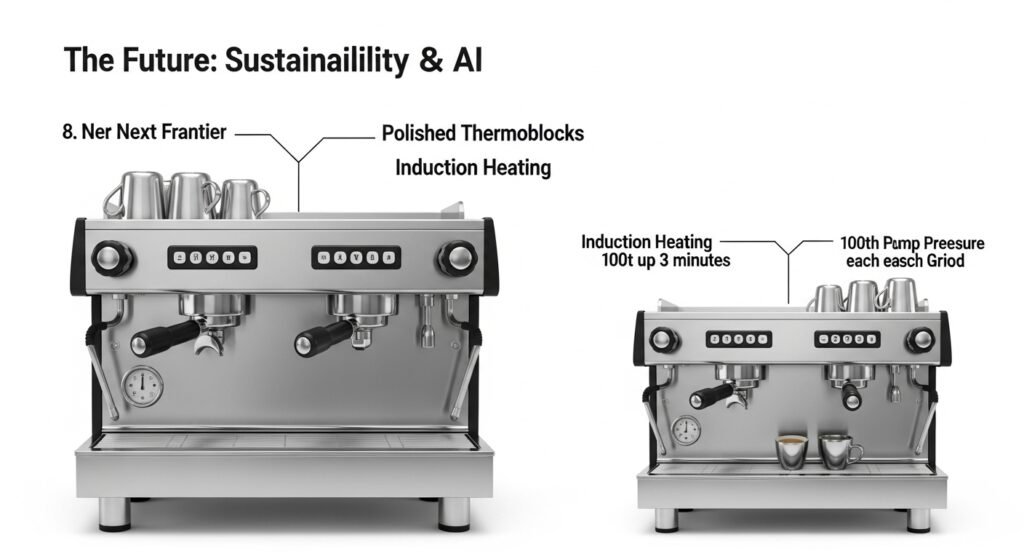
Traditional espresso machines are energy hogs. They take 30 minutes to heat up and use a lot of electricity to keep large boilers hot all day. The newest generation of machines is moving toward “Polished Thermoblocks” and “Induction Heating.”
These machines can heat up in 3 minutes and only heat the exact amount of water needed for the shot. Some are even using AI to “learn” from each shot, automatically adjusting the grind or the pump pressure to ensure the 100th shot tastes exactly like the 1st.
Summary: The Espresso Timeline
| Era | Key Technology | Impact on Flavor |
| 1880s – 1930s | Steam Pressure | Bitter, watery, and scorched. |
| 1940s – 1950s | Piston / Lever | Invention of Crema and heavy body. |
| 1960s – 1980s | Electric Pumps (E61) | Consistency and thermal stability. |
| 1990s – 2010s | Dual Boilers / PID | Precision temperature control. |
| 2020s – Present | Pressure Profiling / AI | Total control over extraction physics. |
Final Thoughts
The espresso machine is a testament to human obsession. We took a simple bean and built a century-long engineering project just to extract the best possible 30 milliliters of liquid from it.
When you look at your espresso machine—whether it’s a simple moka pot or a $5,000 digital beast—you are looking at the culmination of 140 years of trial and error. You are seeing the victory of Gaggia’s spring over steam, the precision of the modern computer over the human arm, and the ongoing quest for the “God Shot.”
The next time you pull a shot, listen to the pump. Watch the crema form. Feel the heat of the group head. You aren’t just making a drink; you are operating a piece of history.
Happy brewing, and may your pressure always stay steady!

Marcelo Clark combines professional industry experience with a passion for democratizing coffee knowledge. Specialist in extraction techniques and an advocate for single-origin beans, Marcelo uses this space to teach beginners how to appreciate the subtle notes of a well-crafted brew. His goal is to make learning about methods and origins simple, relevant, and inspiring for every reader’s daily routine.