
In the world of specialty coffee, we are usually obsessed with freshness. We want beans that were picked recently, roasted days ago, and ground seconds before brewing. We protect them from air, moisture, and heat. But there is one coffee that breaks every single one of those rules.
It is called Monsoon Malabar.
If you were to look at a bag of unroasted Monsoon Malabar, you might think something was wrong. Instead of the vibrant, jade-green color of most raw coffee, these beans are pale, straw-colored, and swollen to nearly twice their normal size. They look old. They look weathered.
But this isn’t a defect; it is a meticulously controlled process that mimics a historical accident. For many, Monsoon Malabar is the most flavorful, low-acid, and “creamy” coffee on the planet. For others, it is an acquired taste. Regardless of where you stand, its story is one of the most fascinating chapters in the global coffee trade.
In this guide, we are going to explore the maritime history of the Malabar coast, the unique “monsooning” process that changes the bean’s DNA, and why this Indian treasure is the secret weapon for some of the world’s best espresso blends.
1. The Wooden Ships and the “Accidental” Roast
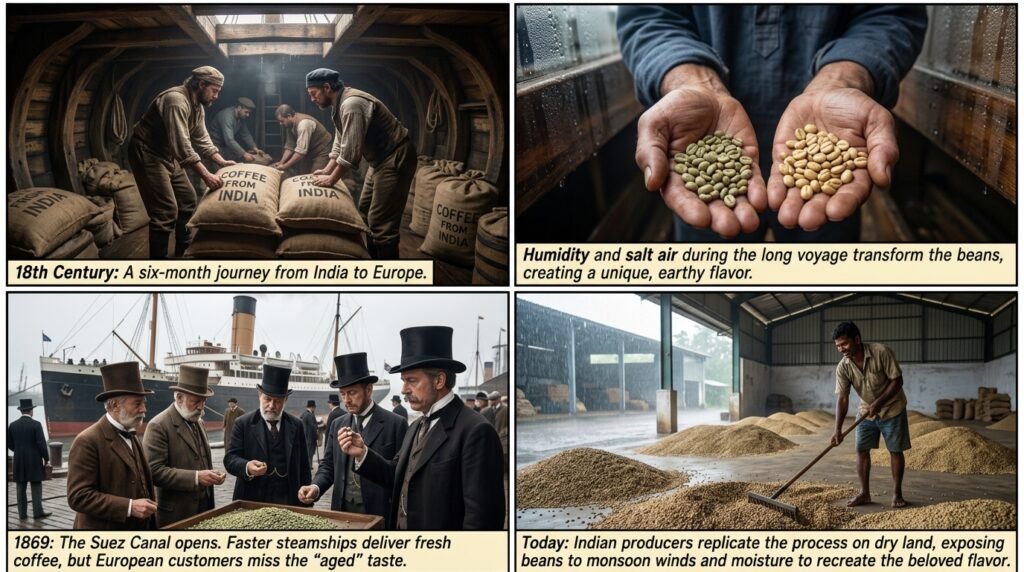
To understand Monsoon Malabar, we have to go back to the days of the British Raj. In the 18th and 19th centuries, coffee was shipped from India to Europe in the holds of wooden sailing ships.
The journey took six months. During this time, the beans were exposed to the extreme humidity of the monsoon winds and the salt air of the Indian Ocean. By the time the ships reached London or Amsterdam, the coffee had changed. The beans had absorbed moisture, lost their acidity, and turned from green to a pale gold.
Europeans grew to love this specific flavor—a heavy, earthy, and spicy profile with almost zero “bite.” However, when the Suez Canal opened and steamships replaced sailing vessels, the journey time was cut down to weeks. The coffee arrived in Europe still “fresh” and green.
The customers were horrified. They complained that the coffee had lost its character. To satisfy the market, Indian producers had to find a way to “recreate” the effects of a six-month sea voyage on dry land.
2. The Monsooning Process: Nature’s Laboratory
Today, “monsooning” is a protected geographic indication (GI) process that can only take place on the Malabar Coast of Southwestern India.
The process begins during the monsoon season (June to September). High-quality Arabica and Robusta beans are spread out in specially designed, open-sided warehouses. As the moist, salt-laden winds sweep in from the Arabian Sea, the beans act like sponges.
The Stages of Monsooning:
-
Spreading: Beans are laid out in layers about 4–6 inches thick.
-
Raking: Workers constantly rake the beans to ensure they are evenly exposed to the humid air. If the beans stay still, they will mold.
-
Bagging and Re-bagging: The beans are packed into jute bags and stacked, then unpacked and spread out again. This cycle is repeated for 12 to 16 weeks.
By the end of the season, the beans have doubled in size and changed color. This physical transformation is a result of a massive chemical shift. As the beans absorb moisture, the chlorogenic acids (which cause acidity) break down. This is why The Chemistry of Extraction: Balancing Acid, Sweet, and Bitter is so different for this coffee; there is almost no acid left to balance, leaving only the “bass notes” of flavor.
3. The Flavor Profile: Earth, Spice, and Smoke
If you are looking for the bright, floral notes of a Kenyan coffee or the citrus punch of a Panamanian, you won’t find it here. Monsoon Malabar exists on the opposite end of the sensory spectrum.
-
Aroma: Pungent, with scents of damp earth, wood-fire, and old leather.
-
Palate: Incredibly heavy body with notes of spice (black pepper, cardamom), tobacco, and dark chocolate.
-
Acidity: Virtually non-existent. It is one of the “flattest” coffees in terms of pH, making it a favorite for people with sensitive stomachs.
This unique profile is why The Science of Coffee Body: What Creates That Syrupy Mouthfeel? is so relevant to India’s coffee. The monsooning process alters the polysaccharides and lipids in the bean, creating a liquid that feels as thick as heavy cream on the tongue.
4. The Espresso Secret: Crema and Stability
While some people enjoy Monsoon Malabar as a single-origin pour-over, its true “superpower” is revealed when it is used in an espresso blend.
Italian espresso traditionalists have used Monsooned Malabar for decades for two reasons:
-
Crema: Because the beans are so porous and have such a unique cellular structure, they produce a massive, stable “head” of crema.
-
Smoothness: The lack of acidity allows a roaster to include higher-caffeine Robusta beans in a blend without the drink becoming harsh or “vinegary.”
When you are Calibrating Your Espresso: The Dialing-In Process, adding just 10% to 20% of Monsoon Malabar can transform a thin, sour shot into a rich, chocolatey masterpiece. It acts as the “anchor” for the more volatile, acidic beans in the blend.

5. Roasting the “Ghost” Bean
Roasting Monsoon Malabar is a challenge for even the most experienced roasters. Because the beans are so large and have so little moisture left (they are essentially “pre-dried” by the wind), they behave differently in the drum.
-
Density: The beans are significantly less dense than standard Arabica. They heat up very quickly and can “scorch” if the temperature is too high.
-
The “First Crack”: The sound of the first crack is often much quieter and harder to hear than with other coffees.
-
Appearance: Because the beans are pale gold to begin with, it’s harder to judge the roast level by eye.
A medium roast is usually the “sweet spot.” If you go too light, the coffee tastes like raw grain. If you go too dark, the delicate spicy notes are replaced by a bitter, charred-wood flavor.
6. Sourcing: Why Ethics Matter on the Malabar Coast
The monsooning process is labor-intensive. It requires constant human intervention—raking, bagging, and monitoring. In India, coffee production is a massive employer, and the Malabar region is home to many smallholder cooperatives.
When buying Monsoon Malabar, look for “AA” grade. This indicates the largest, most uniform beans that have undergone the most careful monsooning. As we’ve discussed in Sustainable Coffee: What ‘Organic’ and ‘Fair Trade’ Really Mean, choosing coffees with a clear geographic indication ensures that the workers preserving this 200-year-old tradition are being supported.
7. How to Brew: Embracing the Weight
Because Monsoon Malabar is so low in acid and high in body, you need to brew it in a way that highlights its texture.
-
The Moka Pot: This is arguably the best way to enjoy this coffee. The pressure of the moka pot works with the monsooned beans to create a syrupy, intense cup that tastes like liquid spice.
-
The French Press: A great choice for highlighting the “earthy” characteristics. Use a slightly coarser grind and a longer steep time (5 minutes) to extract the deep tobacco and cocoa notes.
-
Avoid: The Chemex. The thick paper filter of a Chemex is designed to highlight acidity—the one thing Monsoon Malabar doesn’t have. Using a Chemex will leave you with a “hollow” tasting cup that misses the best parts of the bean.
8. An Acquired Taste: The “Marmite” of Coffee
It is important to be honest: not everyone loves Monsoon Malabar. To some, the “earthy” notes can taste like dirt or mustiness. In the specialty coffee world, where “cleanliness” and “brightness” are often the highest goals, Monsoon Malabar is a rebel.
But for those who find modern light roasts too sour or tea-like, Monsoon Malabar is a revelation. It is a “comfort” coffee. It is the coffee you want on a cold winter morning or as an after-dinner treat with a piece of dark chocolate. It is a reminder that flavor isn’t just about what is “perfect” according to a lab; it’s about history, environment, and the stories we tell through our food.
Summary: Monsoon Malabar Quick Profile
| Characteristic | Detail |
| Origin | Malabar Coast, Karnataka/Kerala, India |
| Process | Exposure to Monsoon winds for 12-16 weeks |
| Appearance | Large, swollen, pale-gold/straw colored |
| Acidity | Extremely Low (pH Neutral) |
| Body | Very Heavy / Syrupy |
| Key Flavors | Earth, Spice, Tobacco, Malt, Dark Cocoa |
Final Thoughts
The Mystery of Monsoon Malabar is a testament to the power of the environment. It shows us that coffee isn’t just a seed; it’s a living thing that continues to change long after it has been picked from the tree.
By embracing the wind and the humidity, Indian producers have preserved a flavor that would otherwise have been lost to the history books. Whether you use it to add “soul” to your espresso blend or brew it as a spicy, earthy single-origin, Monsoon Malabar is a journey back in time.
The next time you see those pale, golden beans, don’t be fooled by their appearance. They aren’t old; they are “monsooned.” And they are ready to show you a side of coffee you’ve never experienced before.
Happy brewing, and may your cup always be as deep as the Arabian Sea!

Marcelo Clark combines professional industry experience with a passion for democratizing coffee knowledge. Specialist in extraction techniques and an advocate for single-origin beans, Marcelo uses this space to teach beginners how to appreciate the subtle notes of a well-crafted brew. His goal is to make learning about methods and origins simple, relevant, and inspiring for every reader’s daily routine.